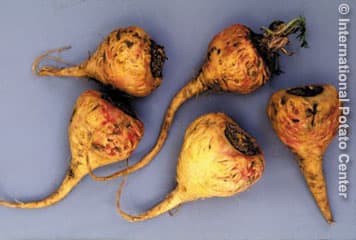
Lepidium meyenii
Lepidium meyenii
Safety & Hazards
None known
Cultivation Details
Maca grows at high altitudes in the Andes in an inhospitable region of intense sunlight, violent winds and below freezing weather. With its extreme temperatures and poor rocky soil, the area rates among the world's worst farmland, yet over the centuries, Maca has learned to flourish under these conditions[1]. It grows best in areas where annual daytime temperatures are within the range 12 - 18°c, but can tolerate 3 - 22°c[2]. Plants grow in areas where frosts are common throughout the growing season and they are said to tolerate temperatures down to at least -10°, perhaps to -20°c if given a good mulch[3]. It prefers a mean annual rainfall in the range 600 - 800mm, but tolerates 500 - 1,000mm[2]. Requires a sunny position[2]. Prefers a well-drained soil with a medium to heavy texture[2]. Prefers a pH in the range 6.5 - 7.5, tolerating 6 - 8.5[2] The plant is said to deplete the soil in which it is grown. In S. America it is grown traditionally on a 10 year rotation, leaving the fields fallow for the next nine years to recover before their next crop[3]. It is most likely that the problem lies with the nutrient-poor and fragile soils that the plant is usually grown in, rather than the greed of the plant[3]. There are some named forms[3]. The roots are usually harvested 6 - 7 months after sowing the seed, though they can take 9 months to mature[3]. Yields of 20 tonnes per hectare are possible[3]. Plants are self-fertile[3]. They are also quite possibly allelopathic (inhibiting the growth of nearby plants)[3].
Propagation
Seed - traditionally it is sown in situ. If growing a small quantity, or in areas outside its native range, then it could be worthwhile sowing the seed in early spring in a cold frame. Either transplant the seedlings into open ground when they have produced 4 - 6 true leaves, or prick them out into individual pots as soon as they are large enough to handle and then plant them out in early summer. Cite as: Temperate Plants Database, Ken Fern. temperate.theferns.info. 2026-02-21. <temperate.theferns.info/plant/Lepidium+meyenii>
Pollinators
Insects
References
- [1]Maca.htm — Raintree Nutrition Inc. · 1999 ↩︎Web site giving lots of info on Lepidium meyenii.
- [2]Ecocrop — http://ecocrop.fao.org/ecocrop/srv/en/home ↩︎Basic information on a wide range of useful plants, plus details of environmental needs where available.
- [3]Lost Crops of the Incas — Popenoe. H. et al · National Academy Press · 1990 · ISBN 0-309-04264-X ↩︎An excellent book. Very readable, with lots of information and good pictures of some lesser known food plants of S. America.
- [4]A Dictionary of Plants Used by Man. — Usher. G. · Constable · 1974 · ISBN 0094579202 ↩︎Forget the sexist title, this is one of the best books on the subject. Lists a very extensive range of useful plants from around the world with very brief details of the uses. Not for the casual reader.
- [5]Cornucopia - A Source Book of Edible Plants. — Facciola. S. · Kampong Publications · 1990 · ISBN 0-9628087-0-9 ↩︎Excellent. Contains a very wide range of conventional and unconventional food plants (including tropical) and where they can be obtained (mainly N. American nurseries but also research institutes and a lot of other nurseries from around the world.
- [6]Wild Food Plants of Australia. — Low. T. · Angus and Robertson. · 1989 · ISBN 0-207-14383-8 ↩︎Well presented, clear information and good photographs. An interesting read for the casual reader as well as the enthusiast
- [7]Dictionary of Economic Plants. — Uphof. J. C. Th. · Weinheim · 1959 · ISBN - ↩︎An excellent and very comprehensive guide but it only gives very short descriptions of the uses without any details of how to utilize the plants. Not for the casual reader.
- [8]CosIng — http://ec.europa.eu/growth/tools-databases/cosing/ ↩︎CosIng is the European Commission database for information on cosmetic substances and ingredients.