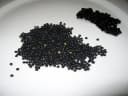
Lens culinaris
Lens culinaris
Safety & Hazards
None known
Cultivation Details
Lentils can be cultivated from the temperate zone to the tropics, so long as there is a growing season of 4 months or more with a fairly dry period as the seed is ripening. In the tropics it can be grown at elevations up to 3,800 metres[1]. It grows best in areas where annual daytime temperatures are within the range 15 - 29°c, but can tolerate 5 - 32°c[1]. The plants are much hardier than is commonly supposed and there is at least one cultivar, called 'WH2040', that can withstand temperatures as low as -23°c in the seedling stage[2]. The plant prefers a mean annual rainfall in the range 600 - 1,000mm, but tolerates 250 - 2,500mm[1]. Dry conditions must prevail just prior to, and at, harvest time[1]. An easily grown plant[PFAF], it prefers a sandy soil in a warm sunny sheltered position[3, 4, 2]. Another report says that it does best on clay[4]. The plant can grow well on many soil types, so long as they are well-drained[5]. It produces most seed when grown on poorer soils, richer soils tending to favour vegetative growth at the expense of flowering[4, 1]. Prefers a pH in the range 5.5 - 7.5, tolerating 4.5 - 8.2[1]. There are several cultivars that are suitable for growing in temperate climates. 'WH2040', can withstand temperatures as low as -23°c in the seedling stage[2]. 'Chilean' is a low-growing plant that can be grown in the winter in areas where winter vegetables can be grown[6]. 'HarLen' tolerates temperatures down to -10°c and performs very well in garden situations[6]. Flowering usually starts 6 - 7 weeks after sowing the seed. Early maturing cultivars can produce a seed crop in 70 - 120 days, late cultivars take 120 - 130 days[5, 1]. Lentils are harvested when the pods turn yellow-brown and the lower ones are still firm. Further delay may lead to shattering. In many areas the plant is cut down manually to ground level and left to dry for about 10 days, before being threshed and winnowed. Alternatively, for instance in Ethiopia, lentils are harvested by hand-pulling the plants, after which they are left in the field to dry to a seed moisture content of 12 - 13%[5]. The common yield of seed under dry conditions is about 340 - 670 kilos per hectare, increasing to between 900 - 1,700 kilos at more favourable sites[1]. In some areas yields of 3 - 4 tonnes per hectare have been achieved[1]. There are many named varieties[6, 7]. Lentils are very beneficial to grow as part of a rotation on the farm or garden. They have a symbiotic relationship with certain soil bacteria, these bacteria form nodules on the roots and fix atmospheric nitrogen. Some of this nitrogen is utilized by the growing plant but some can also be used by other plants growing nearby and, if the roots are left in the ground when the seeds are harvested, this will provide a source of nitrogen for the next crop[2].
Propagation
Seed - sow early mid spring in situ[8]. Some cultivars are probably suitable for sowing outdoors in the autumn, at least in the milder parts of the temperate zone[2]. A dormancy period of 4 - 6 weeks after harvest is common, and some cultivars have been found to be responsive to vernalization[299. The minimum temperature for germination is 15°c and the optimum temperature 18 - 21°c; temperatures above 27°c are harmful. At optimum temperatures, the seeds germinate in 5 - 6 days[5]. Seeds can remain viable for more than 5 years under cool and dry storage conditions[5] Cite as: Temperate Plants Database, Ken Fern. temperate.theferns.info. 2026-02-21. <temperate.theferns.info/plant/Lens+culinaris>
Pollinators
Cleistogamous, Insects
References
- [1]Ecocrop — http://ecocrop.fao.org/ecocrop/srv/en/home ↩︎Basic information on a wide range of useful plants, plus details of environmental needs where available.
- [2]The New RHS Dictionary of Gardening. 1992. — Huxley. A. · MacMillan Press · 1992 · ISBN 0-333-47494-5 ↩︎Excellent and very comprehensive, though it contains a number of silly mistakes. Readable yet also very detailed.
- [3]The Vegetable Garden. — Vilmorin. A. · Ten Speed Press · ISBN 0-89815-041-8 ↩︎A reprint of a nineteenth century classic, giving details of vegetable varieties. Not really that informative though.
- [4]The Gardener's Assistant. — Thompson. B. · Blackie and Son. · 1878 · ISBN - ↩︎Excellent general but extensive guide to gardening practices in the 19th century. A very good section on fruits and vegetables with many little known species.
- [5]Protabase - Plant Resources of Tropical Africa. — http://www.prota.org ↩︎An excellent on-line database with detailed information on over 3,200 species of useful plants of Africa.
- [6]Cornucopia - A Source Book of Edible Plants. — Facciola. S. · Kampong Publications · 1990 · ISBN 0-9628087-0-9 ↩︎Excellent. Contains a very wide range of conventional and unconventional food plants (including tropical) and where they can be obtained (mainly N. American nurseries but also research institutes and a lot of other nurseries from around the world.
- [7]Cornucopia II — Facciola. S. · Kampong Publications, California. · 1998 · ISBN 0-9628087-2-5 ↩︎The second edition of an excellent guide to the edible uses of plants, though it does not give any details of cultivation etc.
- [8]RHS Dictionary of Plants plus Supplement. 1956 — F. Chittendon. · Oxford University Press · 1951 · ISBN - ↩︎Comprehensive listing of species and how to grow them. Somewhat outdated, it has been replaced in 1992 by a new dictionary (see [ 200 ]).
- [9]Economic Botany. — Hill. A. F. · The Maple Press · 1952 · ISBN - ↩︎Not very comprehensive, but it is quite readable and goes into some detail about the plants it does cover.
- [10]Plants for Human Consumption. — Kunkel. G. · Koeltz Scientific Books · 1984 · ISBN 3874292169 ↩︎An excellent book for the dedicated. A comprehensive listing of Latin names with a brief list of edible parts.
- [11]Herbs — Phillips. R. & Foy. N. · Pan Books Ltd. London. · 1990 · ISBN 0-330-30725-8 ↩︎Deals with all types of herbs including medicinal, culinary, scented and dye plants. Excellent photographs with quite good information on each plant.
- [12]A Dictionary of Plants Used by Man. — Usher. G. · Constable · 1974 · ISBN 0094579202 ↩︎Forget the sexist title, this is one of the best books on the subject. Lists a very extensive range of useful plants from around the world with very brief details of the uses. Not for the casual reader.
- [13]Glossary of Indian Medicinal Plants (Including the Supplement). — Chopra. R. N., Nayar. S. L. and Chopra. I. C. · Council of Scientific and Industrial Research, New Delhi. · 1986 · ISBN - ↩︎Very terse details of medicinal uses of plants with a wide range of references and details of research into the plants chemistry. Not for the casual reader.
- [14]Plant Resources of Southeast Asia — http://proseanet.org/ ↩︎Lots of information on the uses of the plants of SE Asia.
- [PFAF]Plants for a Future — pfaf.org ↩︎