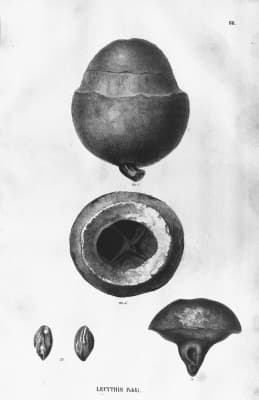
Lecythis lanceolata
Lecythis lanceolata
Safety & Hazards
None known
Cultivation Details
Plants are probably not very fussy as to soil type[1]. They prefer a sunny position[1], but can also succeed in dappled shade[2]. Trees have been known to produce their first crop in less than ten years from seed[1]. Unlike the related Brazil nut, which only produces its seeds towards the top of the tree, this species can fruit right down to the lower branches[1]. It has been estimated that individual trees could produce about 80 kilos of seeds per year[1]. The seeds take 18 months to mature after flowering[3]. The fruits, which are suspended from the ends of branches, develop a perfectly fitting 'lid', which drops off as the nuts ripen, thus scattering the seeds[1, 3]. These fruits have been used as monkey traps. A bait is placed inside the empty fruit, which the monkey puts its hand inside to grab and then finds it cannot withdraw its hand (unless it releases the bait of course)[3].
Propagation
Seed - it only has a short period of viability so should be sown as soon as it is ripe[1]. Sow the seed in individual containers in a lightly shaded position. Germination rates in excess of 50% can be expected, with the seeds sprouting within 5 - 7 weeks[2]. Seedlings are ready for planting into their permanent positions when about 7 - 8 months old[2]. Cite as: Tropical Plants Database, Ken Fern. tropical.theferns.info. 2026-02-20. <tropical.theferns.info/viewtropical.php?id=Lecythis+lanceolata>
Pollinators
Data unavailable
References
- [1]Nuts. — Howes. F. N. · Faber · 1948 · ISBN - ↩︎Rather old but still a masterpiece. Has sections on tropical and temperate plants with edible nuts plus a section on nut plants in Britain. Very readable.
- [2]Brazilian Trees. Volume 2. 4th Edition. — Lorenzi. H. · Instituto Plantarum De Estudos Da Flora; Brazil. · 2002 · ISBN 85-86714-15-1 ↩︎Information on 350 species of Brazilian trees. Stunning photographs of each species, brief details on the plant, its uses and how to grow it from seed. A superb work, with the minor irritation that the translation from Portuguese is not of the best.
- [3]The New RHS Dictionary of Gardening. 1992. — Huxley. A. · MacMillan Press · 1992 · ISBN 0-333-47494-5 ↩︎Excellent and very comprehensive, though it contains a number of silly mistakes. Readable yet also very detailed.
- [4]Brazilian Fruits and Cultivated Exotics — Lorenzi. H.; Bacher. L.; Lacerda. M.; Sartori. S. · Instituto Plantarum De Estudos Da Flora LTDA; Brazil. · 2000 · ISBN 85-867174-24-0 ↩︎A superb book, giving information on several hundred fruit species. Each entry has a brief description of the plant and its uses, accompanied by one to many excellent quality photographs of the fruits.
- [5]IUCN Red List of Threatened Species — http://www.iucnredlist.org/ ↩︎A list of plants under threat and facing possible extinction, usually with brief details of the threats and information on habitat.
- [6]Cornucopia II — Facciola. S. · Kampong Publications, California. · 1998 · ISBN 0-9628087-2-5 ↩︎The second edition of an excellent guide to the edible uses of plants, though it does not give any details of cultivation etc.
- [7]Tropical Timbers of the World. Ag. Handbook No. 607. — Chudnoff. Martin. · USDA Forest Service. Wisconsin. · 1984 ↩︎Terse details on the properties of the wood of almost 400 species of trees from the Tropics.