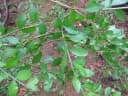
Lawsonia inermis
Lawsonia inermis
Safety & Hazards
None known
Cultivation Details
A plant of the dry to moist tropics and subtropics, where it is found at elevations up to 2,000 metres. It grows best in areas where annual daytime temperatures are within the range 19 - 27°c, but can tolerate 13 - 33°c[1]. It prefers a mean annual rainfall in the range 500 - 1,500mm, but tolerates 250 - 4,200mm[1]. Prefers a fertile, well-drained or dry soil in a sunny position[2, 3]. A very greedy plant, removing large quantities of nutrients from the soil[1]. The plant is tolerant of poor, stony and sandy soils, but is also well adapted to heavy, fertile clay soils[4]. Prefers a pH in the range 5 - 7, tolerating 4.3 - 8[1]. Established plants are very drought tolerant[1]. Henna can grow to the size of a large shrub or even small tree, but in cultivation is normally treated as a short-lived perennial crop and then grows up to 70cm tall[4]. Plants produce their best yields during the first 4 - 8 years after planting, but are often left in the field for 12 - 15 years, sometimes for as long as 40 years[1]. Under irrigation, yields of dry leaves may be 2 - 4 tonnes per hectare, while under rain fed conditions in northern India yields of 700 - 1,500 kilos per hectare are obtained[1]. Under intensive cultivation the plants are usually harvested twice a year from the second year onwards[1]. A very variable plant[5]. There are two main forms, one with creamy white blooms, the other with light red[3]. Both forms are heavily fragrant, although the cream form is more intensely so[3]. Its odour at short range is rank and overpowering, but from a distance it is like that of mignonette[6]. Plants flower all year round, though the seed capsules need to be removed since they inhibit flowering[3].
Propagation
Seed - germinates best at temperatures around 25°c[4]. Because of their hard seedcoats, the seeds have to be pre-germinated before sowing. They are first steeped in water for 3 - 7 days, during which time the water is changed daily. They are then placed in small heaps and kept moist and warm for a few days. Care is taken to drain excess water. When the seedcoat has softened and the seed has started to swell, it is ready to be sown in a nursery. During the first days after sowing, the soil should be kept moist and daily irrigations are often required. When the plants are about 40cm tall they are lifted, cut back to about 15cm and transplanted[4]. Softwood cuttings root easily. Branches with 6 - 8 buds are used[4]. Hardwood cuttings root easily. Branches with 6 - 8 buds are used[4]. Layers. Cite as: Tropical Plants Database, Ken Fern. tropical.theferns.info. 2026-02-20. <tropical.theferns.info/viewtropical.php?id=Lawsonia+inermis>
Pollinators
Data unavailable
References
- [1]Ecocrop — http://ecocrop.fao.org/ecocrop/srv/en/home ↩︎Basic information on a wide range of useful plants, plus details of environmental needs where available.
- [2]Tropical Ornamentals; A Guide — Whistler. W. Arthur. · Timber Press Inc. Oregon. · 2000 · ISBN 0-88192-448-2 ↩︎An excellent little guide to some of the more commonly cultivated ornamental plants of the Tropics, often giving some information on the plants other uses.
- [3]Tropical and Subtropical Trees - A Worldwide Encyclopaedic Guide. — Barwick. M. · Thames & Hudson, London · 2004 · ISBN 0-500-51181-0 ↩︎A superb book, very concise and well written, giving a wealth of information on 400 or more species including descriptions, habitat, cultivation details and plant uses. A wealth of colour photographs bring each plant vividly to life.
- [4]Protabase - Plant Resources of Tropical Africa. — http://www.prota.org ↩︎An excellent on-line database with detailed information on over 3,200 species of useful plants of Africa.
- [5]Flora of Pakistan — http://www.efloras.org ↩︎As of 2006, there is not much information on habitats available, but it is being developed and promises to be an excellent resource.
- [6]The Useful Plants of the Island of Guam — Safford W.E. · Smithsonian Institute; Washington. · 1905 · http://www.biodiversitylibrary.org/ ↩︎A very comprehensive, if rather dated, guide to the plants of Guam. It can be downloaded from the Internet.
- [7]World Agroforesty Centre — http://www.worldagroforestry.org/ ↩︎An excellent online database of a huge range of trees giving very good information on each plant - its uses, ecology, identity, propagation, pests etc.
- [8]The Encyclopedia of Medicinal Plants — Chevallier. A. · Dorling Kindersley. London · 1996 · ISBN 9-780751-303148 ↩︎An excellent guide to over 500 of the more well known medicinal herbs from around the world.
- [9]Encyclopaedia of Herbs and their Uses. — Bown. D. · Dorling Kindersley, London. · 1995 · ISBN 0-7513-020-31 ↩︎A very well presented and informative book on herbs from around the globe. Plenty in it for both the casual reader and the serious student. Just one main quibble is the silly way of having two separate entries for each plant.
- [10]Medicinal Plants of the Guianas — DeFilipps, R. A.; Maina, S. L.; & Crepin, J. · Smithsonian Museum · http://botany.si.edu/bdg/medicinal/index.html ↩︎A down-loadable PDF document of a book in pre-publication awaiting illustration. An excellent, if rather terse, guide to the traditional medicinal uses of the plants of the region
- [11]Dictionary of Economic Plants. — Uphof. J. C. Th. · Weinheim · 1959 · ISBN - ↩︎An excellent and very comprehensive guide but it only gives very short descriptions of the uses without any details of how to utilize the plants. Not for the casual reader.
- [12]Plants and People of Nepal — Manandhar. N. P. · Timber Press. Oregon. · 2002 · ISBN 0-88192-527-6 ↩︎Excellent book, covering over 1,500 species of useful plants from Nepal together with information on the geography and peoples of Nepal. Good descriptions of the plants with terse notes on their uses.