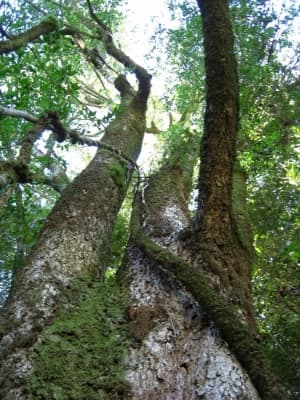
Laurelia sempervirens
Laurelia sempervirens
Safety & Hazards
None known
Cultivation Details
Laurelia sempervirens is a tree of the sub-tropics and is not very hardy outside the milder regions of the temperate zone. It is said to tolerate temperatures down to about -5°c[1], though another report says that plants have withstood temperatures down to -11°c[2]. It succeeds outdoors in the mildest areas of the UK, growing well and flowering regularly in Cornwall[3, 4]. Succeeds in sun or semi-shade in any moderately fertile soil, including a limey soil, so long as it does not dry out in the growing season[1]. Requires a warm position sheltered from cold winds[1]. The foliage is very aromatic[5]. If required for its wood, it is necessary to cut the tree only when the sap is down[6]. There appear to be two forms of this species. That formerly known as Laurelia serrata (now treated as a synonym) has a more southerly range and yields an inferior timber - on this form the bark is odourless and the wood has an unpleasant smell. The form with the more northerly range has an aromatic bark and the wood is odourless[3]. The tree grows to immense size in the Cordilleran foothills of the south of Chile, and gradually diminishes in size as it is found north of the river Bio Bio[6]. Plants are often dioecious, male and female forms will need to be grown if fruit and seed is required.
Propagation
Seed - sow late winter or early spring in a warm greenhouse. Germination rates are variable[7]. When they are large enough to handle, prick the seedlings out into individual pots and grow them on in the greenhouse for at least their first winter. Plant them out into their permanent positions in late spring or early summer, after the last expected frosts, and consider giving them some protection from the cold for their first winter or two outdoors. Cuttings of half-ripe wood, 5 - 8cm with a heel, mid summer in individual pots in sandy soil in a frame. Keep them moist. Fair percentage[7]. Layering in spring[7]. Cite as: Temperate Plants Database, Ken Fern. temperate.theferns.info. 2026-02-21. <temperate.theferns.info/plant/Laurelia+sempervirens>
Pollinators
Insects
References
- [1]The New RHS Dictionary of Gardening. 1992. — Huxley. A. · MacMillan Press · 1992 · ISBN 0-333-47494-5 ↩︎Excellent and very comprehensive, though it contains a number of silly mistakes. Readable yet also very detailed.
- [2]The Garden. Volume 111. — RHS. · Royal Horticultural Society · 1986 · ISBN - ↩︎Snippets of information from the magazine of the RHS, including an article on Crambe maritima and another on several species thought to be tender that are succeeding in a S. Devon garden.
- [3]Trees and Shrubs Hardy in Great Britain. Vol 1 - 4 and Supplement. — Bean. W. · Murray · 1981 · ISBN - ↩︎A classic with a wealth of information on the plants, but poor on pictures.
- [4]Trees and Shrubs in Cornwall. — Thurston. ↩︎Trees and shrubs that succeed in Cornwall based on the authors own observations. Good but rather dated.
- [5]The RHS Gardener's Encyclopedia of Plants and Flowers — Brickell. C. · Dorling Kindersley Publishers Ltd. · 1990 · ISBN 0-86318-386-7 ↩︎Excellent range of photographs, some cultivation details but very little information on plant uses.
- [6]Inventory of Seeds and Plants Imported Vol. 21 — USDA Government Printing Office; Washington DC. · 1911 · http://www.biodiversitylibrary.org ↩︎Details of seeds imported for trials by the United States Department of Agriculture in the last quarter of 1909, often detailing the uses of the plant and various other miscellaneous information. It can be downloaded from the Internet.
- [7]Propagation of Trees, Shrubs and Conifers. — Sheat. W. G. · MacMillan and Co · 1948 · ISBN - ↩︎A bit dated but a good book on propagation techniques with specific details for a wide range of plants.
- [8]South American Timbers: the Properties, Uses and Characteristics of 190 Species. — Bolza. E. & Christensen. F.J. · Commonwealth Scientific and Industrial Research Organization · 1979 · ISBN 0 643 02582 0 ↩︎A very useful guide.
- [9]IUCN Red List of Threatened Species — http://www.iucnredlist.org/ ↩︎A list of plants under threat and facing possible extinction, usually with brief details of the threats and information on habitat.
- [10]Cornucopia - A Source Book of Edible Plants. — Facciola. S. · Kampong Publications · 1990 · ISBN 0-9628087-0-9 ↩︎Excellent. Contains a very wide range of conventional and unconventional food plants (including tropical) and where they can be obtained (mainly N. American nurseries but also research institutes and a lot of other nurseries from around the world.
- [11]Sturtevant's Edible Plants of the World. — Hedrick. U. P. · Dover Publications · 1972 · ISBN 0-486-20459-6 ↩︎Lots of entries, quite a lot of information in most entries and references.
- [12]Dictionary of Economic Plants. — Uphof. J. C. Th. · Weinheim · 1959 · ISBN - ↩︎An excellent and very comprehensive guide but it only gives very short descriptions of the uses without any details of how to utilize the plants. Not for the casual reader.
- [13]A Dictionary of Plants Used by Man. — Usher. G. · Constable · 1974 · ISBN 0094579202 ↩︎Forget the sexist title, this is one of the best books on the subject. Lists a very extensive range of useful plants from around the world with very brief details of the uses. Not for the casual reader.
- [14]Plants for Human Consumption. — Kunkel. G. · Koeltz Scientific Books · 1984 · ISBN 3874292169 ↩︎An excellent book for the dedicated. A comprehensive listing of Latin names with a brief list of edible parts.
- [15]Flora of Chile. (in Spanish) — ? ↩︎Some information about the useful plants of Chile.
- [16]Tropical Timbers of the World. Ag. Handbook No. 607. — Chudnoff. Martin. · USDA Forest Service. Wisconsin. · 1984 ↩︎Terse details on the properties of the wood of almost 400 species of trees from the Tropics.