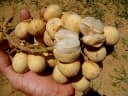
Lansium domesticum
Lansium domesticum
Safety & Hazards
An arrow poison is made from the fruit peel and the bark of the tree. Both possess a toxic property, lansium acid, which, on injection, arrests heartbeat in frogs. The seed contains a minute amount of an unnamed alkaloid and two bitter, toxic principles[1].
Cultivation Details
Langsat is an ultra-tropical plant[1]. It is a tree of tropical lowland forest and even in its native range it cannot be grown at elevations above 650 - 750 metres[1]. The temperature range for growth is reported to be 12 - 40°c with the optimum between 20 - 35°c[1]. It needs a humid atmosphere, plenty of moisture and will not tolerate long dry seasons[1]. The annual rainfall range for growth is reported to be 1,000 - 3,000mm with the optimum between 1,400 - 2,200mm[1]. It can cope with a dry season, if shade and moisture supply are adequate[1]. In Java, for example, the tree grows in areas with 6 - 12 wet months if there is over 100 mm rainfall monthly[1]. Young plants require shade from strong sun, but older plants can tolerate full sun, though some shade is still beneficial[2]. Grows best in a slightly acid, humus-rich, well-drained, fertile soil[2, 3]. Dislikes heavy soils[3]. Prefers a pH in the range 6 - 6.5, tolerating 5.5 - 7.5[4]. The trees are shallow rooted and greatly benefit from a thick layer of organic matter to protect their numerous feeding roots[5]. A slow-growing plant, the seedlings take 12 - 20 years before they bear their first crop, whilst grafted trees can beging cropping within 5 - 6 years[1, 2, 5]. Trees do not always grow and fruit well outside Asia. There are successful commercial orchards in Surinam, though the plant has been unfruitful in Honduras. It succeeds in Trinidad and Puerto Rico[1]. In the Philippines, a productive tree averages 1,000 fruits per year, where it is grown in half shade interplanted with coconut[1]. There are two distinct botanical varieties in the Malay Peninsula, with a third form grown in Java:- 'Pubescens' is the typical wild langsat which is a rather slender, open tree with hairy branchlets and nearly round, thick-skinned fruits having much milky latex. Although often referred to as the wild type, it is commonly cultivated and shows considerable range of form, size and quality[1]. The fruit spikes are long, carrying 15 - 25 ovoid, thin-skinned fruits which exude latex until fully ripe. The taste is generally (sub)acid and refreshing. Langsat is adapted to more seasonal climates further from the equator than the following form[5]. 'Domesticum', often called the duku, doekoe, or dookoo, is a more robust tree, broad-topped and densely foliaged with conspicuously-veined leaflets; the fruits, borne few to a cluster, are oblong-ovoid or ellipsoid, with thin, brownish skin, only faintly aromatic and containing little or no milky latex[1]. Duku bears shorter fruit spikes, usually with few fruits. Generally sweet and aromatic, the fruits are normally larger and more rounded than the langsat fruit, with a thick skin (up to 6 mm) and relatively free from latex. The trees appear to be more suited to the humid tropics[5]. 'Kokossan' is a form found mainly in Java - its trees have the largest flowers and most pubescent leaves. The globose, orange yellow fruits are smaller, they have a tough pericarp and contain latex. The seeds are not removed when eating the fruit - instead a hole is bitten into the skin and the juice sucked out[6]. There are desirable types in each group. Some small fruits are completely seedless and fairly sweet[1]. The plant commonly sets fruit (and seed) without prior fertilization (parthenocarpic)[5].
Propagation
Langsats are commonly grown from seeds, which have a short viability and must be planted within 1-2 days after removal from the fruit[1]. Sow in a shaded position in a nursery seedbed. Germination can start after 10 days, with about 90% germinating within one month. Multiple seedlings, resulting from polyembryony, are fairly common[5]. Cleft-, side- and approach-grafting give good results. The budwood should be mature but not old, 6.5-9 cm long, 6-20 mm thick, and it is joined to rootstock of the same diameter about 6.5-10 cm above the soil Cite as: Tropical Plants Database, Ken Fern. tropical.theferns.info. 2026-02-20. <tropical.theferns.info/viewtropical.php?id=Lansium+domesticum>
Pollinators
Apomictic
References
- [1]World Agroforesty Centre — http://www.worldagroforestry.org/ ↩︎An excellent online database of a huge range of trees giving very good information on each plant - its uses, ecology, identity, propagation, pests etc.
- [2]Tropical and Subtropical Trees - A Worldwide Encyclopaedic Guide. — Barwick. M. · Thames & Hudson, London · 2004 · ISBN 0-500-51181-0 ↩︎A superb book, very concise and well written, giving a wealth of information on 400 or more species including descriptions, habitat, cultivation details and plant uses. A wealth of colour photographs bring each plant vividly to life.
- [3]Digital Compendium of Forestry Species of Cambodia — www.digitalspecies.blogspot.com; Phnom Penh · 2008 · http://www.digitalspecies.blogspot.com ↩︎A very detailed booklet, produced in PDF format on the internet, giving information on around 100 species of trees.
- [4]Ecocrop — http://ecocrop.fao.org/ecocrop/srv/en/home ↩︎Basic information on a wide range of useful plants, plus details of environmental needs where available.
- [5]Plant Resources of Southeast Asia — http://proseanet.org/ ↩︎Lots of information on the uses of the plants of SE Asia.
- [6]Flora Malesiana Series 1 — Various · Nationaal Herbarium Nederiand, Universiteit Leiden branch · http://www.archive.org ↩︎A massive treatment of the plants of the Malaysian Archipelago. Much of it has been made available to download from the Internet
- [7]Perennial Edible Fruits of the Tropics : an Inventory — Martin, F. W.; Campbell, C. W.; Rubertbe, R. M. · U.S. Dept. of Agriculture, Agricultural Research Service · 1987 ↩︎A booklet giving terse details of almost 300 species of edible fruits, plus regional lists of Botanical and Common names for over 2,500 less well-known edible fruits of the tropics.
- [8]Cornucopia II — Facciola. S. · Kampong Publications, California. · 1998 · ISBN 0-9628087-2-5 ↩︎The second edition of an excellent guide to the edible uses of plants, though it does not give any details of cultivation etc.