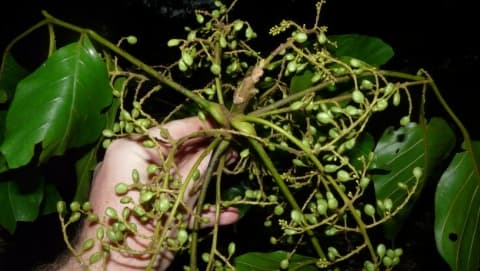
Lannea welwitschii
Lannea welwitschii
Safety & Hazards
The sawdust may cause allergic reactions to the skin and mucous membranes[1].
Cultivation Details
A plant of low to moderate elevations in the moist tropics. In Ethiopia it is found in regions with a mean annual rainfall of 1,500 - 2,000mm[1]. A fast-growing tree[1]. Trees respond well to coppicing and pollarding[1]. Natural regeneration is most abundant in medium-large gaps in the forest[1]. A dioecious species, both male and female forms need to be grown if fruit and seed are required[1].
Propagation
Seed - best sown as soon as it is ripe, the seed does not need pre-treatment. It can be sown in a moderately sunny position in a nursery seedbed, or in situ. Germination rates are usually quite low, about 30%, with the seed sprouting in 1 - 3 weeks[1]. The fruits should be gradually dried before they are stored; they can be kept for up to 2 months in sealed containers in a cool place[1]. Cite as: Tropical Plants Database, Ken Fern. tropical.theferns.info. 2026-02-20. <tropical.theferns.info/viewtropical.php?id=Lannea+welwitschii>
Pollinators
Data unavailable
References
- [1]Protabase - Plant Resources of Tropical Africa. — http://www.prota.org ↩︎An excellent on-line database with detailed information on over 3,200 species of useful plants of Africa.
- [2]The Useful Plants of West Tropical Africa. — Burkil. H. M. · Royal Botanic Gardens; Kew. · 1985 - 2004 ↩︎Brief descriptions and details of the uses of over 4,000 plants. A superb, if terse, resource, it is also available electronically on the Web - see http://www.aluka.org/
- [3]IUCN Red List of Threatened Species — http://www.iucnredlist.org/ ↩︎A list of plants under threat and facing possible extinction, usually with brief details of the threats and information on habitat.
- [4]Field Guide to the Moist Forest Trees of Tanzania. — Lovett J.C.; Ruffo C.K.; Gereau R.E.; Taplin J.R.D · Frontier · http://www.york.ac.uk/res/celp/webpages/projects/ecology/tree%20guide/introduction.htm · ISBN 1-873070-33-0 ↩︎A lovely little book giving a basic identification guide to more than 650 species of trees growing in Tanzania. It is also available to view on the internet.
- [5]Lost Crops of Africa. Vol. 3 Fruits. — National Academy Press · 2008 · ISBN 030910596X ↩︎Masses of information on about 70 species of plants that have been utilized as fruits in Africa.