Lannea edulis
Lannea edulis
Safety & Hazards
None known
Cultivation Details
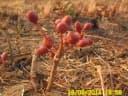
The plant has a deeply penetrating root system that anchors the it and endows it exceptional survivability under drought stress[1]. The plant is acaulescent, or at least does not develop much above the surface of the soil and thus escapes the annual fires that are so common within much of its range[2]. At the end of the dry season, bunches of small flowers pop out directly from the leafless stems, each bunch hanging from the bare wood and looking for all the world like creamy-yellow tinsel sprinkled over the land. People like these almost magical flowers, which are harbingers of the rains and of the better times soon to arrive[1]. Later, the fruits begin forming. Eventually, they hang in grape-like bunches almost touching the ground, ripening slowly from pink through scarlet to wine-red and eventually black. Inside their thin skin is found smooth green flesh and a bean-shaped stone. In most the layer of pulp is thin, but whatever there is normally is juicy and pleasantly sour. They are exceptionally popular, particularly with children. Throughout much of southern Africa, kids squeezing tree grapes between their fingers and shooting the pulp into their mouths is a common sight[1].
Propagation
Seed - Cite as: Tropical Plants Database, Ken Fern. tropical.theferns.info. 2026-02-20. <tropical.theferns.info/viewtropical.php?id=Lannea+edulis>
Pollinators
Data unavailable
References
- [1]Lost Crops of Africa. Vol. 3 Fruits. — National Academy Press · 2008 · ISBN 030910596X ↩︎Masses of information on about 70 species of plants that have been utilized as fruits in Africa.
- [2]Inventory of Seeds and Plants Imported. Vol. 62 — USDA Government Printing Office; Washington DC. · 1923 · http://www.biodiversitylibrary.org ↩︎Details of seeds and plants imported for trials by the United States Department of Agriculture in the first quarter of 1920, often detailing the uses of the plant and various other miscellaneous information. It can be downloaded from the Internet.
- [3]Flora Zambesiaca — http://apps.kew.org/efloras/fz/intro.html ↩︎An excellent online flora of plants from the Zambezi River basin. It lists a number of the plant uses as well as the habitats and botanical descriptions of the plants.
- [4]African Flowering Plants Database — Conservatoire et Jardin Botaniques. · http://www.ville-ge.ch/musinfo/bd/cjb/africa/recherche.php ↩︎Contains information on over 150,000 plant names (including synonyms) giving a description and habitat, plus a distribution map.
- [5]Global Tree Campaign - 40 Species in Trade — http://www.unep-wcmc.org/trees/trade/40_species_in_trade.htm ↩︎Information on the habitats, uses and some cultivation notes for 40 species of timber trees.
- [6]Flora Capensis — Hiern. W.P.; Brown N.E. · 1909 · http://www.aluka.org/action/doBrowse?sa=1&st=662543&execbr=&sls= ↩︎Rather dated, and many of the botanical names have been changed since it was written, but contains a wealth of information about plants of southern Africa. It can be downloaded or viewed online.