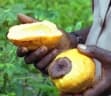
Landolphia owariensis
Landolphia owariensis
Safety & Hazards
None known
Cultivation Details
In the Nigerian and Cameroons high-forest, yields of 22 - 180 kg per sq mile of forest (period not stated, but presumably per year) were recorded, and a skilled tapper could obtain 7½ kg per month, at the expense of much dangerous tree-climbing[1]. This is certainly the commonest of the Landolphia spp. It survives bush-fires, and its rhizomes after a burn often put up a coppice of short shoots which even before becoming lignified will bear flowers and fruits[1].
Propagation
Seed. For the first couple of years the seedlings are slow growing and remain short and stubby bushes, but they then begin elongating and take on the appearance of vines. At that time they are removed from the nursery and planted in the field. If given a chance, this gumvine grows straight up the trunks of trees, making its way to the top of the forest canopy[1]. Cuttings. Cite as: Tropical Plants Database, Ken Fern. tropical.theferns.info. 2026-02-20. <tropical.theferns.info/viewtropical.php?id=Landolphia+owariensis>
Pollinators
Data unavailable
References
- [1]The Useful Plants of West Tropical Africa. — Burkil. H. M. · Royal Botanic Gardens; Kew. · 1985 - 2004 ↩︎Brief descriptions and details of the uses of over 4,000 plants. A superb, if terse, resource, it is also available electronically on the Web - see http://www.aluka.org/
- [2]Lost Crops of Africa. Vol. 3 Fruits. — National Academy Press · 2008 · ISBN 030910596X ↩︎Masses of information on about 70 species of plants that have been utilized as fruits in Africa.