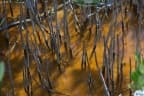
Laguncularia racemosa
Laguncularia racemosa
Safety & Hazards
None known
Cultivation Details
A plant of tropical coastal areas. It grows best in areas where annual daytime temperatures are within the range 20 - 30°c, but can tolerate 10 - 38°c[1]. It prefers a mean annual rainfall in the range 1,500 - 2,500mm, but tolerates 800 - 7,000mm[2, 1]. Grows best in a sunny position, tolerating light shade[1]. Succeeds on a wide variety of soil types, including silt, clay, sand, peat, and marl[2]. Tolerates high levels of salt in the soil[1]. Prefers a pH in the range 5.5 - 7, tolerating 4.5 - 7.5[1]. A fast-growing tree, seedlings attain a height of approximately 60 to 90 cm after 1 year in the nursery and can then be planted out[2, 1]. Flowering starts when plants are about 2 years old and occurs all year round[3]. Fruiting is abundant and usually a carpet of seedlings is produced but most seedlings die in the first year[3]. The species is often regarded as somewhat weedy in nature and frequently invades sites planted with R. Mangle or Avicennia germinans[2]. Most glands on the leaf blade function as salt glands and the salt solution may crystallize so rapidly that crystals are extruded in chains from the mouth of the gland[3]. The plant is predominantly dioecious, but bisexual individuals are also found[3]. In general, both male and female plants need to be grown if seed is required,
Propagation
Seed - typically root in 5 to 10 days with no pre-treatment. Seeds can also be soaked until the radicle emerges about 1 cm and then sowed by carefully inserting the radicle into the soil[2]. If the propagules are soaked before sowing, the water should be changed frequently, ideally every day[2]. Rooted cuttings. Vegetative propagation is important in reforestation programmes in mangrove-suitable areas. The most important factor for survival of cuttings is rooting of the shoots prior to cutting from the parent trees. Under natural conditions rooting occurs often after flooding. Rooted cuttings can even be planted in salt water and they start flowering within a year[3]. The seeds begin germination whilst still on the tree or while floating in the water, and floating seeds commonly have roots[[2]. The seeds can be collected directly from the trees, from the soil surface, or while they are floating in open water[2]. Little information is available on storage of the seed, but storage for longer than about 10 days is not recommended[2]. Cite as: Tropical Plants Database, Ken Fern. tropical.theferns.info. 2026-02-20. <tropical.theferns.info/viewtropical.php?id=Laguncularia+racemosa>
Pollinators
Bees
References
- [1]Ecocrop — http://ecocrop.fao.org/ecocrop/srv/en/home ↩︎Basic information on a wide range of useful plants, plus details of environmental needs where available.
- [2]Tropical Tree Seed Manual — Vosso. J. Editor. · USDA Forest Service. · 2002 · http://www.rngr.net/Publications/ttsm ↩︎An extremely good guide, it can also be downloaded in its entirety from the address shown above.
- [3]Protabase - Plant Resources of Tropical Africa. — http://www.prota.org ↩︎An excellent on-line database with detailed information on over 3,200 species of useful plants of Africa.