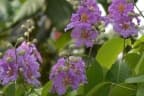
Lagerstroemia speciosa
Lagerstroemia speciosa
Safety & Hazards
The roots, stems and leaves contain hydrocyanic acid[1].
Cultivation Details
A plant of the moist, lowland tropics and subtropics, where it is found at elevations up to 400 metres. It grows best in areas where annual daytime temperatures are within the range 18 - 35°c, but can tolerate 6 - 43°c[2]. When dormant, the plant can survive temperatures down to about -2°c, but young growth can be severely damaged at -1°c[2]. It prefers a mean annual rainfall in the range 2,000 - 3,500mm, but tolerates 1,300 - 5,000mm[2]. Thrives in a position in full sun on a wide range of moist, well drained soils[3, 4]. Grows best on rich, deep, alluvial loams with good drainage, but can also grow in badly-draind swampy ground, though it is likely to be small and crooked[5]. Tolerant of alkaline soils, but not of saline conditions[3]. Prefers a pH in the range 5.5 - 6.5, tolerating 4.5 - 7.5[2]. The tree has been successfully grown in urban areas where air pollution, poor drainage, compacted soil, and/or drought are common[3]. Not a tree to plant and forget, it appreciates regular fertilization or the leaves become chlorotic. Young seedlings are very slow growing for their first year, but then speed up. Three year old plants, grown on fertile, irrigated soil, reached a height of 3 metres; without irrigation they were 2.4 metres tall[5]. In trials in Java, 15-year-old trees attained a mean annual increment of 9 - 11mm in diameter and 70 - 90cm in height[1]. In trials at planting distances of 3 metres x 1 metre on fertile soil in Java the canopy closed after 6 years and the first thinning was necessary after 8 years[1]. The tree coppices freely and is fairly resistant to fire[1]. Seedlings can flower when only 2 years old[4]. The tree should tolerate storms well, having hard wood with flexible branches; as long as they are well spaced along the trunk and not clumped together growing from one point on the trunk[3]. The bark is thin and easily injured[3]. The tree wants to grow with several trunks but can be trained to grow with a single trunk[3]
Propagation
Seed - germinates readily[3]. Seeds should be sown in the shade, germination takes 15 - 56 days[1]. After germination the small seedlings can be pricked out and transferred to containers[1]. Seedlings grow slowly, often being no more than 5 - 30cm tall at the end of their first year - they usually speed up somewhat after this[5]. Stumps with a shoot length of 5-10 cm, a root length of 10-20 cm and a diameter of 5-25 mm have shown 90-100 % survival[1]. Seeds can store for at least 2 years in airtight containers at room temperature[1]. Cuttings. Division of root suckers. Cite as: Tropical Plants Database, Ken Fern. tropical.theferns.info. 2026-02-20. <tropical.theferns.info/viewtropical.php?id=Lagerstroemia+speciosa>
Pollinators
Bees
References
- [1]World Agroforesty Centre — http://www.worldagroforestry.org/ ↩︎An excellent online database of a huge range of trees giving very good information on each plant - its uses, ecology, identity, propagation, pests etc.
- [2]Ecocrop — http://ecocrop.fao.org/ecocrop/srv/en/home ↩︎Basic information on a wide range of useful plants, plus details of environmental needs where available.
- [3]Institute of Food and Agricultural Sciences, University of Florida — University of Florida · http://hort.ifas.ufl.edu/shrubs/ ↩︎PDF fact sheets on over 500 shrubs.
- [4]Dominica Botanic Gardens — http://www.da-academy.org/trees_shrubs.html ↩︎An on-line resource, providing top quality pictures and some basic information on various plants being grown at the Botanic Gardens, often including uses and habitat.
- [5]Brazilian Trees. Volume 3. — Lorenzi. H. · Instituto Plantarum De Estudos Da Flora; Brazil. · 2009 · ISBN 85-86714-34-4 ↩︎Information on 350 species of Brazilian trees. Stunning photographs of each species, brief details on the plant, its uses and how to grow it from seed. A superb work, with the minor irritation that the translation from Portuguese is not of the best.
- [6]Trees of Sungai Wain — http://www.nationaalherbarium.nl/Sungaiwain/ ↩︎An excellent site with factsheets on almost 1,000 species of forest trees growing at Sungai Wain in Indonesia. Each factsheet has good quality pictures plus basic information on the ecology and uses of the plants.
- [7]A Field Guide to Forest Trees of Northern Thailand — Gardener S.; Sidisunthorn P.; Anusarnsunthorn V. · Kobfai Publishing Project; Bangkok. · 2000 · ISBN 974-7799-01-4 ↩︎An excellent, concise guide to 430 species, plus notes on another 450 species. Excellent photographs and a separate section on distribution and plant uses.
- [8]Dictionary of Economic Plants. — Uphof. J. C. Th. · Weinheim · 1959 · ISBN - ↩︎An excellent and very comprehensive guide but it only gives very short descriptions of the uses without any details of how to utilize the plants. Not for the casual reader.
- [9]A Manual of the Timbers of the World — Howard A.L. · MacMillan and Co.; London. · 1934 · http://www.biodiversitylibrary.org ↩︎An excellent and comprehensive book on timbers. Rather dated, but still a main source of information for many of the less known woods. It can be downloaded from the Internet.
- [10]Tropix 7 — CIRAD · http://tropix.cirad.fr/en ↩︎An on-line guide to the timbers of 245 species of trees.
- [11]Identification and utilization of lesser-known commercial timbers in Peninsular Malaysia 6 — Lim S.C. & Gan K.S. · Forest Research Institute; Malaysia · 2006 · http://www.frim.gov.my/?page_id=1842 · ISBN 139-258 ↩︎Part of an excellent series of publications, this one giving a brief guide to four lesser known groups of commercial timbers from southeast Asia. It is available in PDF format on the Internet.