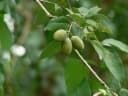
Lagerstroemia parviflora
Lagerstroemia parviflora
Safety & Hazards
None known
Cultivation Details
A plant of tropical areas, where it is found at elevations up to 1,000 metres[1]. It grows best in areas where the mean minimum temperature does not fall below 20°c, and the mean maximum is no higher than 35°c, though it can tolerate a low down to 4°c and maximum to 47°c[1]. Mature trees are fairly frost-hardy, although young seedlings are very frost-tender[1]. It prefers a climate with a distinct dry season, growing best where the mean annual rainfall is in the range 1,500 - 3,500mm, but tolerating a range of 750 - 4,500mm[1]. Grows best in a sunny position[1]. Prefers a medium soil, but also succeeds in sands and in clays if they are well-drained[2, 3]. Prefers a pH in the range 5.5 - 6.5, but can tolerate 4.5 - 7.5[1]. Established plants are drought tolerant[3]. A fairly slow-growing tree[3]. Trees respond well to coppicing and pollarding, regrowing vigourously[3]. Trees are rarely, if ever, eaten by cattle[3].
Propagation
Seed - in some years virtually none of the seed germinates, though in some years germination can be very good[3]. Sow the seed in a nursery seedbed with some shade. Growth is relatively fast, seedlings can reach a height of 30cm within 12 months, by which time they are ready to plant out. Cite as: Tropical Plants Database, Ken Fern. tropical.theferns.info. 2026-02-20. <tropical.theferns.info/viewtropical.php?id=Lagerstroemia+parviflora>
Pollinators
Data unavailable
References
- [1]Ecocrop — http://ecocrop.fao.org/ecocrop/srv/en/home ↩︎Basic information on a wide range of useful plants, plus details of environmental needs where available.
- [2]Annals of the Missouri Botanical Garden Vol. 65 — Missouri Botanical Garden · 1978 ↩︎An excellent botanical publication, available for download from the Internet. This volume contains parts of the Flora of Panama.
- [3]Brazilian Trees. Volume 3. — Lorenzi. H. · Instituto Plantarum De Estudos Da Flora; Brazil. · 2009 · ISBN 85-86714-34-4 ↩︎Information on 350 species of Brazilian trees. Stunning photographs of each species, brief details on the plant, its uses and how to grow it from seed. A superb work, with the minor irritation that the translation from Portuguese is not of the best.
- [4]A Manual of Indian Timbers. — Gamble. J. S. · Bishen Singh Mahendra Pal Singh · 1972 · ISBN - ↩︎First written in the 19th century, but still a classic, giving a lot of information on the uses and habitats of Indian trees. Not for the casual reader.
- [5]The Silviculture of Indian Trees — Troup. R.S. · Oxford, at the Clarendon Press · 1921 · http://www.biodiversitylibrary.org ↩︎An excellent treatment.
- [6]Economic Products of India. Volume 1. — Watt. G. · Government of India: Calcutta. · 1883 ↩︎Although over 100 years old, it still contains a wealth of information on useful plants. Many of the botanical names have been changed since then, so you have to check for up to date names. The book can be downloaded from the Internet.
- [7]Inventory of Seeds and Plants Imported. Vol. 59 — USDA Government Printing Office; Washington DC. · 1922 · http://www.biodiversitylibrary.org ↩︎Details of seeds and plants imported for trials by the United States Department of Agriculture in the second quarter of 1919, often detailing the uses of the plant and various other miscellaneous information. It can be downloaded from the Internet.
- [8]Dictionary of Economic Plants. — Uphof. J. C. Th. · Weinheim · 1959 · ISBN - ↩︎An excellent and very comprehensive guide but it only gives very short descriptions of the uses without any details of how to utilize the plants. Not for the casual reader.
- [9]A Manual of the Timbers of the World — Howard A.L. · MacMillan and Co.; London. · 1934 · http://www.biodiversitylibrary.org ↩︎An excellent and comprehensive book on timbers. Rather dated, but still a main source of information for many of the less known woods. It can be downloaded from the Internet.
- [10]Tropical Timbers of the World. Ag. Handbook No. 607. — Chudnoff. Martin. · USDA Forest Service. Wisconsin. · 1984 ↩︎Terse details on the properties of the wood of almost 400 species of trees from the Tropics.