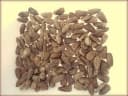
Lagenaria siceraria
Lagenaria siceraria
Safety & Hazards
The pulp surrounding the seed is toxic[1].
Cultivation Details
Lagenaria siceraria is a plant of the moist, lowland tropics and subtropics. It can be grown at elevations up to 1,600 metres, but economic crops are only produced below 500 metres[2]. It grows best in areas where annual daytime temperatures are within the range 19 - 27°c, but can tolerate 12 - 38°c[2]. Plants are killed by frosts. It prefers a mean annual rainfall in the range 1,200 - 1,800mm, but tolerates 700 - 2,800mm[2]. Prefers a warm sunny position sheltered from the wind[3]. Prefers a well-drained, moist, good rich circumneutral soil[4, 5, 3, 6]. Requires plenty of moisture in the growing season[4]. Prefers a pH in the range 5.5 - 7, tolerating 4.5 - 7.5[2]. Plants grow very rapidly and, in optimum conditions, the stems can produce 60cm of new growth in 24 hours[3, 7]. It can take 70 - 90 days from seed to produce harvestable immature fruits, and 100 - 120 days for mature fruits[2]. The plants are frost-tender annuals, they grow very rapidly and even in temperate regions their stems can reach a length of 9 metres in the summer[3]. A warm summer, however, is required for good production of the fruit[3]. Temperate summers are often too cool or too short for this species and obtaining a crop from outdoor-grown plants can be somewhat problematical. The best chance is by starting the plants off early in a warm greenhouse, growing them on fast and then planting them out as soon as possible but making sure that they are not checked by cold weather. Hand pollination of the fruits can increase fruit set[8]. Some cultivars have a relatively short growing period of 60 - 80 days[2]. Individual plants can yield about 10 - 15 fruits[2]. Good yields may be about 20 - 30 tonnes per hectare, and optimal yields may be up to 40 - 60 tonnes[2]. Hand pollination of the fruits can increase fruit set[8]. There are many named varieties with different shaped and sized fruits[3, 9, 8, 10]. The variety 'Cougourda' is said to be the best for eating[11]. Forms with wooden shells tend not to have an edible flesh[8]. The leaves have a strong musky scent that some people find repulsive[8]. The plant is remarkably disease and pest-free, this might be connected to the smell of the leaves[8].
Propagation
Seed - sow spring in a greenhouse in a rich soil, putting 2 - 3 seeds in a pot and thinning to the strongest plant. Grow on fast and plant out as soon as possible after the last expected frosts, giving some protection until the plants are established and growing well. The seed germinates best at 25°c[3]. Soaking the seeds for 12 hours in warm water prior to sowing can hasten germination[3]. Discard any seeds that have not germinated after 10 days, the plants they produce will not be vigorous enough to succeed outdoors in most temperate regions[3]. Cite as: Temperate Plants Database, Ken Fern. temperate.theferns.info. 2026-02-21. <temperate.theferns.info/plant/Lagenaria+siceraria>
Pollinators
Moths, Insects
References
- [1]Medicinal Plants of the Guianas — DeFilipps, R. A.; Maina, S. L.; & Crepin, J. · Smithsonian Museum · http://botany.si.edu/bdg/medicinal/index.html ↩︎A down-loadable PDF document of a book in pre-publication awaiting illustration. An excellent, if rather terse, guide to the traditional medicinal uses of the plants of the region
- [2]Ecocrop — http://ecocrop.fao.org/ecocrop/srv/en/home ↩︎Basic information on a wide range of useful plants, plus details of environmental needs where available.
- [3]Gourds. — Organ. J. · Faber · 1963 · ISBN - ↩︎Deals with squashes and their relatives. Interesting and readable, it gives cultivation techniques and some details of plant uses.
- [4]RHS Dictionary of Plants plus Supplement. 1956 — F. Chittendon. · Oxford University Press · 1951 · ISBN - ↩︎Comprehensive listing of species and how to grow them. Somewhat outdated, it has been replaced in 1992 by a new dictionary (see [ 200 ]).
- [5]The Vegetable Garden. — Vilmorin. A. · Ten Speed Press · ISBN 0-89815-041-8 ↩︎A reprint of a nineteenth century classic, giving details of vegetable varieties. Not really that informative though.
- [6]The New RHS Dictionary of Gardening. 1992. — Huxley. A. · MacMillan Press · 1992 · ISBN 0-333-47494-5 ↩︎Excellent and very comprehensive, though it contains a number of silly mistakes. Readable yet also very detailed.
- [7]Vegetables in the Tropics — Tindall. H. D. · MacMillan, Oxford. · 1983 · ISBN 0-333-24268-8 ↩︎An excellent, in-depth look at the main vegetable crops that can be grown in the Tropics, plus many less well-known plants.
- [8]Oriental Vegetables — Larkcom J. · John Murray · 1991 · ISBN 0-7195-4781-4 ↩︎Well written and very informative.
- [9]Cornucopia - A Source Book of Edible Plants. — Facciola. S. · Kampong Publications · 1990 · ISBN 0-9628087-0-9 ↩︎Excellent. Contains a very wide range of conventional and unconventional food plants (including tropical) and where they can be obtained (mainly N. American nurseries but also research institutes and a lot of other nurseries from around the world.
- [10]Cornucopia II — Facciola. S. · Kampong Publications, California. · 1998 · ISBN 0-9628087-2-5 ↩︎The second edition of an excellent guide to the edible uses of plants, though it does not give any details of cultivation etc.
- [11]Fruits of the Earth. — Bianchini. F., Corbetta. F. and Pistoia. M. ↩︎Lovely pictures, a very readable book.
- [12]Protabase - Plant Resources of Tropical Africa. — http://www.prota.org ↩︎An excellent on-line database with detailed information on over 3,200 species of useful plants of Africa.
- [13]Sturtevant's Edible Plants of the World. — Hedrick. U. P. · Dover Publications · 1972 · ISBN 0-486-20459-6 ↩︎Lots of entries, quite a lot of information in most entries and references.
- [14]Dictionary of Economic Plants. — Uphof. J. C. Th. · Weinheim · 1959 · ISBN - ↩︎An excellent and very comprehensive guide but it only gives very short descriptions of the uses without any details of how to utilize the plants. Not for the casual reader.
- [15]Chinese Materia Medica. — Stuart. Rev. G. A. · Taipei. Southern Materials Centre · 1911 · ISBN - ↩︎A translation of an ancient Chinese herbal. Fascinating.
- [16]Plants for Human Consumption. — Kunkel. G. · Koeltz Scientific Books · 1984 · ISBN 3874292169 ↩︎An excellent book for the dedicated. A comprehensive listing of Latin names with a brief list of edible parts.
- [17]Glossary of Indian Medicinal Plants (Including the Supplement). — Chopra. R. N., Nayar. S. L. and Chopra. I. C. · Council of Scientific and Industrial Research, New Delhi. · 1986 · ISBN - ↩︎Very terse details of medicinal uses of plants with a wide range of references and details of research into the plants chemistry. Not for the casual reader.
- [18]Native American Ethnobotany — Moerman. D. · Timber Press. Oregon. · 1998 · ISBN 0-88192-453-9 ↩︎Very comprehensive but terse guide to the native uses of plants. Excellent bibliography, fully referenced to each plant, giving a pathway to further information. Not for the casual reader.
- [19]Medicinal Plants of China — Duke. J. A. and Ayensu. E. S. · Reference Publications, Inc. · 1985 · ISBN 0-917256-20-4 ↩︎Details of over 1,200 medicinal plants of China and brief details of their uses. Often includes an analysis, or at least a list of constituents. Heavy going if you are not into the subject.
- [20]Plants and People of Nepal — Manandhar. N. P. · Timber Press. Oregon. · 2002 · ISBN 0-88192-527-6 ↩︎Excellent book, covering over 1,500 species of useful plants from Nepal together with information on the geography and peoples of Nepal. Good descriptions of the plants with terse notes on their uses.
- [21]A Dictionary of Plants Used by Man. — Usher. G. · Constable · 1974 · ISBN 0094579202 ↩︎Forget the sexist title, this is one of the best books on the subject. Lists a very extensive range of useful plants from around the world with very brief details of the uses. Not for the casual reader.
- [22]The Ethno-Botany of Pre-Columbian Peru. — Towle. M. A. · Aldine Publishing Co. Chicago. · 1961 ↩︎A very interesting book covering quite a lot of information on plant uses in S. America although many of the plants are not suitable for temperate areas.
- [23]Useful Plants of the Siona and Secoya Indians of Eastern Ecuador. — Vickers W.T.; Plowman T. · Field Museum of Natural History; USA. · 1984 · http://www.biodiversitylibrary.org · ISBN 0015 - 0746 ↩︎Very terse, but it gives the uses of a large number of species. It can be downloaded from the Internet.
- [PFAF]Plants for a Future — pfaf.org ↩︎