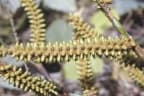
Cultivation Details
Plants succeed in moist tropical climates where temperatures never fall below 10°c, the average annual rainfall is 1,500mm or more and the driest month has 25mm or more rain[3]. A monocarpic species, it can grow for many years without flowering, then flowers prolifically before setting seed and dying. The flowers are produced in panicles at the ends of the stems[2]. Many species n this genus have a close association with ants that make their nests within swollen structures in the leaf sheaths known as ocreas. The ant-rattan relationship also seems to involve the presence of scale insects that are husbanded by the ants for honey dew on young rattan tissue. Ants occupying the ocreas of some species can be extremely aggressive[1].
Propagation
Seed - pre-soak 24 hours in warm water and sow in containers[3]. The seed needs to be fresh for satisfactory germination[3] Cite as: Tropical Plants Database, Ken Fern. tropical.theferns.info. 2026-02-20. <tropical.theferns.info/viewtropical.php?id=Korthalsia+laciniosa>
Pollinators
Data unavailable
References
- [1]Plant Resources of Southeast Asia — http://proseanet.org/ ↩︎Lots of information on the uses of the plants of SE Asia.
- [2]Annals of the Royal Botanic Garden, Calcutta. Vol. 12 Part 2 — Beccari O. · Bengal Secretariat Book Depot; Calcutta · 1916 · http://www.biodiversitylibrary.org ↩︎A botanical journal, this volume has an extensice treatment of the Asiatic Palms in the subfamily Lepidocaryeae. Although dated, it remains a classic work.
- [3]Palms of the World — Blombery. A. & Rodd. T. · Angus and Robertson · 1992 · ISBN 0-207-14848-1 ↩︎An excellent guide, well illustrated, with information on cultivation, uses, habitat etc of almost 200 species of Palms.
- [4]A Field Guide of the Rattans of Cambodia — Khou Eang Hourt · World Wildlife Fund · 2008 ↩︎A draft publication giving an excellent concise guide to the various rattan species growing in Cambodia.
- [5]A Field Guide to Philippine Rattans — Aida C. Baja-Lapis · Rushing Water Publishers Ltd; Philippines · 2010 · ISBN 0117-3375 ↩︎A very useful book with concise information on the various rattan species that grow in the Philippines
- [PFAF]Plants for a Future — pfaf.org ↩︎