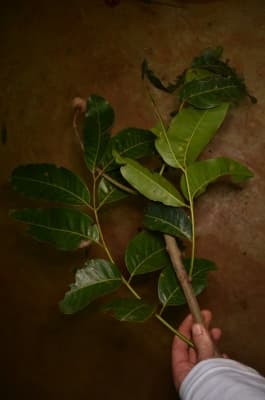
Khaya grandifoliola
Khaya grandifoliola
Safety & Hazards
The bark is used as a fish poison[1].
Cultivation Details
A plant of low to mid elevations in moist tropical regions, being found at elevations up to 1,400 metres in areas where the annual rainfall is in the range 1,200 - 1,800 mm, and there is a dry season of 3 - 5 months[1]. Prefers a moist but well-drained soils[1]. In the wild it is locally common on alluvial soils in valleys[1]. The growth rate of young trees can be quite good. In Nigeria saplings reached an average height of 4.2 metres, and a bole diameter of 7 cm, 4 years after planting[1]. Trees planted in the open in the semi-deciduous forest zone of Cote D'Ivoire reached an average height of 13.5 metres and an average bole diameter of 17 cm after 10 years[1]. However, trees planted in the evergreen forest zone only reached 9 metres in height and 11.5 cm in diameter after 8 years[1]. In Nigeria, an average height of 21 metres after 20 years was recorded[1]. Seeds can germinate in full sun as well as in the shade, but natural regeneration may be very sparse in the forest where seedlings often show very poor growth and do not survive long[1]. Natural regeneration can be abundant in savannah which is close to the forest and protected from fire[1]. The presence of endotrophic mycorrhizal fungi in nurseries is important; inoculation with Endogone spores markedly improved the growth of seedlings[1].
Propagation
Seed - does not require pre-treatment. It is best sown in seed beds in the nursery or in pots[1]. Upon sowing, the seeds should be covered with only a thin layer of soil, or left partially uncovered, but should not be allowed to dry out[1]. Germination takes 10 - 35 days - fresh healthy seeds have a high germination rate of about 90%, but this decreases rapidly to nearly zero after 2 months under natural circumstances[1]. It has been recommended to provide light shade to young seedlings until they are 1 - 2 months old, but in Nigeria it was found that seedlings grew best with full light, watering at least every second day[1]. Seedlings can be left in the nursery for about one year until they are 0.5 - 1 metre tall, after which the root system is pruned to a length of about 30 cm and most leaves stripped off before planting into the field[1]. The seeds are often already attacked by insects while they are still on the tree, and undamaged seeds should therefore be selected before sowing[1]. The seeds can be stored in a cool place; it is recommended to add ash during storage to reduce insect attacks[1]. Cite as: Tropical Plants Database, Ken Fern. tropical.theferns.info. 2026-02-20. <tropical.theferns.info/viewtropical.php?id=Khaya+grandifoliola>
Pollinators
Bees, Moths
References
- [1]Protabase - Plant Resources of Tropical Africa. — http://www.prota.org ↩︎An excellent on-line database with detailed information on over 3,200 species of useful plants of Africa.
- [2]Flora Zambesiaca — http://apps.kew.org/efloras/fz/intro.html ↩︎An excellent online flora of plants from the Zambezi River basin. It lists a number of the plant uses as well as the habitats and botanical descriptions of the plants.
- [3]Tropix 7 — CIRAD · http://tropix.cirad.fr/en ↩︎An on-line guide to the timbers of 245 species of trees.