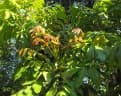
Cultivation Details
A plant of the tropics, where it is found at elevations up to 1,500 metres. It grows best in areas where annual daytime temperatures are within the range 18 - 28°c, but can tolerate 14 - 36°c[2]. The plant cannot tolerate frosts[3]. It prefers a mean annual rainfall in the range 600 - 1,600mm, but tolerates 500 - 1,800mm[2]. Requires a position in full sun[4]. Prefers a deep, fertile, medium to light, well-drained soil[4]. Trees tend to be unstable in shallow clay soils[4]. Prefers a pH in the range 5 - 7, tolerating 4.5 - 7.5[2]. In Ghana the average height of seedling trees after 30 months was 2.5 metres and the average stem diameter 4 - 4.5cm[1]. In Côte d’Ivoire, young trees planted in the open in the semi-deciduous forest zone reached an average height of 12 metres and an average bole diameter of 18cm after 10 years[1]. However, trees planted in the evergreen forest zone were only 6 metres tall and 9cm in diameter after 8 years[1]. In Malawi, planted trees reached a height of 8 metres and a diameter of 9cm after 7 years[1]. Trees may already develop fruits when they have a bole diameter of 18cm, but abundant fruiting usually starts at diameters above 70cm. This means that the removal of trees of diameter classes below 70 cm from the forest may result in lack of natural regeneration[1]. For plantations at an age of 30 years, the annual production is 2 - 4 m³/ha[1]. Dispersal of the seeds is by wind. The maximum dispersal distance is over 50 metres, but about 75% of all seeds are dispersed within 30 metres of the parent tree[1]. The tree has a network of surface roots that can cause damage to nearby buildings[4]. Coppices poorly[3, 5].
Propagation
Seed - it can remain viable for a year or more, but germination is much better from seed sown fresh, often nearly 100%[5]. Sowing in lightly shaded nursery seedbeds has been shown to give better results than sowing in containers. Germination can begin in about 3 weeks[3]. Seedlings are potted up into individual containers when they are about 5cm tall and are then grown on for about 12 months until they are 30cm tall and ready for planting out[5]. The tree has been successfully planted as bare rooted, but use of containerized seedlings yields better results[3]. Seed capsules are clipped from trees when the capsules begin to split. The capsules are sun dried until they split and then shelled by hand. The seed is further dried and then stored in sealed containers in a refrigerator, because viability is lost quickly at ambient air temperatures[3]. Cite as: Tropical Plants Database, Ken Fern. tropical.theferns.info. 2026-02-20. <tropical.theferns.info/viewtropical.php?id=Khaya+anthotheca>
Pollinators
Insects
References
- [1]Protabase - Plant Resources of Tropical Africa. — http://www.prota.org ↩︎An excellent on-line database with detailed information on over 3,200 species of useful plants of Africa.
- [2]Ecocrop — http://ecocrop.fao.org/ecocrop/srv/en/home ↩︎Basic information on a wide range of useful plants, plus details of environmental needs where available.
- [3]World Agroforesty Centre — http://www.worldagroforestry.org/ ↩︎An excellent online database of a huge range of trees giving very good information on each plant - its uses, ecology, identity, propagation, pests etc.
- [4]Tropical and Subtropical Trees - A Worldwide Encyclopaedic Guide. — Barwick. M. · Thames & Hudson, London · 2004 · ISBN 0-500-51181-0 ↩︎A superb book, very concise and well written, giving a wealth of information on 400 or more species including descriptions, habitat, cultivation details and plant uses. A wealth of colour photographs bring each plant vividly to life.
- [5]Seed Leaflets — Various · Forest & Landscape. Denmark · http://en.sl.life.ku.dk/Publikationer/Udgivelser/PopulaerPublikationer.aspx?katid={D28373CC-6EF3-4EF8-B097-6D83FABF209E}&serieid={9F1C3DB1-6E7B-4CF1-AF53-F480B0CB40EF}&sort=title ↩︎A series of leaflets, jointly produced by the University of Copenhagen and the Royal Botanic Gardens at Kew, focussing on seed information for a number species, but also giving a lot of other information about each plant.
- [6]IUCN Red List of Threatened Species — http://www.iucnredlist.org/ ↩︎A list of plants under threat and facing possible extinction, usually with brief details of the threats and information on habitat.
- [7]Dictionary of Economic Plants. — Uphof. J. C. Th. · Weinheim · 1959 · ISBN - ↩︎An excellent and very comprehensive guide but it only gives very short descriptions of the uses without any details of how to utilize the plants. Not for the casual reader.
- [8]Tropix 7 — CIRAD · http://tropix.cirad.fr/en ↩︎An on-line guide to the timbers of 245 species of trees.