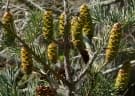
Keteleeria evelyniana
Keteleeria evelyniana
Safety & Hazards
None known
Cultivation Details
Keteleeria evelyniana is one of the few species of Pinaceae occurring in near tropical environments, being found in mountainous areas in SE Asia at elevations from 700 - 2,700 metres, but generally not above 2,000 metres. The climate is humid, tropical at lower elevations but becoming temperate with frosts at higher elevations. It is found in areas where the mean annual temperature is around 18 - 24°c. Plants are not very cold-hardy, being able to tolerate short periods with temperatures down to around -5°c when fully dormant. Mean annual precipitation is often more than 2,000mm and there can be up to 6 months without rain[1, 2]. Grows on neutral and limestone, often shallow soils in the wild[3]. Because of its light demanding habit it is often found on poor soils where competition from shading trees is low[3]. A fairly fast-growing tree, suitable for use in plantations[4]. The plant might be dependant on regular fires in order to propagate successfully[4]. Low temperature, with frost during flower initiation is believed to promote flowering and subsequent seed production[3].
Propagation
Seed - sow in a sandy soil in a warm greenhouse in the spring[5]. When they are large enough to handle, prick the seedlings out into individual pots and grow them on in the greenhouse for at least their first winter. Plant them out into their permanent positions in late spring or early summer, after the last expected frosts. Consider giving the plants some protection from winter cold for their first two winters outdoors. Cuttings of leading shoots from coppiced plants, summer in a frame[1]. Easy[2]. Cite as: Temperate Plants Database, Ken Fern. temperate.theferns.info. 2026-02-21. <temperate.theferns.info/plant/Keteleeria+evelyniana>
Pollinators
Wind
References
- [1]The New RHS Dictionary of Gardening. 1992. — Huxley. A. · MacMillan Press · 1992 · ISBN 0-333-47494-5 ↩︎Excellent and very comprehensive, though it contains a number of silly mistakes. Readable yet also very detailed.
- [2]IUCN Red List of Threatened Species — http://www.iucnredlist.org/ ↩︎A list of plants under threat and facing possible extinction, usually with brief details of the threats and information on habitat.
- [3]Seed Leaflets — Various · Forest & Landscape. Denmark · http://en.sl.life.ku.dk/Publikationer/Udgivelser/PopulaerPublikationer.aspx?katid={D28373CC-6EF3-4EF8-B097-6D83FABF209E}&serieid={9F1C3DB1-6E7B-4CF1-AF53-F480B0CB40EF}&sort=title ↩︎A series of leaflets, jointly produced by the University of Copenhagen and the Royal Botanic Gardens at Kew, focussing on seed information for a number species, but also giving a lot of other information about each plant.
- [4]Conifers of Vietnam — Luu N.D.T.; Thomas P.I. · Darwin Initiative · 2004 · http://www.ceh.ac.uk/sections/bm/conifer_manual.html · ISBN 1-872291-64-3 ↩︎Described by the publishers as an illustrated field guide for the most important forest trees of Vietnam, it is available as a PDF document on the Internet.
- [5]RHS Dictionary of Plants plus Supplement. 1956 — F. Chittendon. · Oxford University Press · 1951 · ISBN - ↩︎Comprehensive listing of species and how to grow them. Somewhat outdated, it has been replaced in 1992 by a new dictionary (see [ 200 ]).
- [6]Flora of China — Missouri Botanical Garden Press; St. Louis. · 1994 · http://flora.huh.harvard.edu/china/ ↩︎An excellent, comprehensive resource in 25 volumes. In addition to the botanical information the flora also gives basic information on habitat and some uses. An on-line version is also available.
- [7]Biotik, Laos — http://biotik.org/species_list_laos.html ↩︎Information on more than 100 species of Laotian trees.
- [8]New Trees — Grimshaw J.; Bayton R.; Wilks H. · Kew Publishing; London · 2009 · ISBN 1842461737 ↩︎Provides comprehensive botanical descriptions and horticultural commentary on over 800 tree species that have been introduced to cultivation in recent decades.
- [9]Trees of Laos and Vietnam - A Field Guide to 100 species. — Hoang Van Sam; Khamseng Nanthavong; Kessler P.J.A. · Blumea · 2004 ↩︎A detailed guide, with excellent line-drawings, to 100 of the more important trees of Laos and Vietnam. A very good work, giving lots of information about each plant. Originally published in the journal Blumea, it is available as a PDF on the Interne