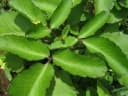
Kalanchoe pinnata
Kalanchoe pinnata
Safety & Hazards
Plants contain bufadienolide cardiac glycosides that can cause cardiac poisoning, particularly in grazing animals[1].
Cultivation Details
Prefers a sunny position but tolerant of some shade. Found mainly in drier soils in the wild, it is tolerant of a wide range of soils and conditions in cultivation so long as the soil is well drained. Established plants are drought tolerant. The plant spreads easily by means of the small plantlets produced on the leaves. Although widely grown as an ornamental, it has also commonly escaped from cultivation and has become a weed in many areas of the tropics[2]. Small plantlets develop along the notches of the leaf margins; these can develop while still attached to the plant or when detached[3].
Propagation
Seed - Small plantlets are produced along the edges of leaves - these can be detatched and grown on. Easy to propagate vegetatively - just one leaf with part of its stem, when set on the soil, will produce roots and grow into a new plant. Cite as: Tropical Plants Database, Ken Fern. tropical.theferns.info. 2026-02-20. <tropical.theferns.info/viewtropical.php?id=Kalanchoe+pinnata>
Pollinators
Data unavailable
References
- [1]Australian Tropical Rainforest Plants — http://www.anbg.gov.au/cpbr/cd-keys/rfk/index.html ↩︎An online resource giving botanical information, and a little bit about plant usage, for over 2,700 species of plants found in the Australian rainforest.
- [2]Pacific Island Ecosystems at Risk — http://www.hear.org/pier/scientificnames/index.html ↩︎A very good website detailing weed species that have been introduced into the Pacific Islands.
- [3]Flora Malesiana Series 1 — Various · Nationaal Herbarium Nederiand, Universiteit Leiden branch · http://www.archive.org ↩︎A massive treatment of the plants of the Malaysian Archipelago. Much of it has been made available to download from the Internet
- [4]Medicinal Plants of the Philippines — Bureau of Plant Industry, Philippines. · http://www.bpi.da.gov.ph/Publications/mp/mplants.html ↩︎An Internet site from the Philippines Department of Agriculture, giving information in a readable way on the medicinal uses of many plants in their area.
- [5]Medicinal Plants in Papua New Guinea — World Health Organisation · 2009 · ISBN 978-92-9061-249-0 ↩︎Traditional medicinal uses of 126 species from Papua New Guinea, including information on modern research into the plants.
- [6]The Useful Plants of the Island of Guam — Safford W.E. · Smithsonian Institute; Washington. · 1905 · http://www.biodiversitylibrary.org/ ↩︎A very comprehensive, if rather dated, guide to the plants of Guam. It can be downloaded from the Internet.
- [7]Medicinal Plants of the Guianas — DeFilipps, R. A.; Maina, S. L.; & Crepin, J. · Smithsonian Museum · http://botany.si.edu/bdg/medicinal/index.html ↩︎A down-loadable PDF document of a book in pre-publication awaiting illustration. An excellent, if rather terse, guide to the traditional medicinal uses of the plants of the region
- [8]Medicinal Plants in Vietnam — Nguyen Van Dan & Doan Thi Nhu · World Health Organisation · 1989 · ISBN 92 9061 101 4 ↩︎An excellent book, giving information on over 200 plants, their medicinal compounds and applications.