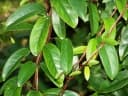
Kadsura japonica
Kadsura japonica
Safety & Hazards
None known
Cultivation Details
Kadsura japonica is native to the warm temperate and subtropical climate in eastern Asia. It has moderate cold resistance and can tolerate winter temperatures falling as low as -10°c for short periods[1]. Succeeds in any fertile garden soil[2]. Requires a sheltered position in a moderately fertile well-drained neutral to acid soil[1]. Prefers a position in semi-shade[3]. The flowers emit a soft sweet perfume[4]. Flowers are produced on the current year's growth[3]. Plants do not really require pruning[3]. Plants can be monoecious or dioecious. When dioecious, both, male and female forms need to be grown if fruit and seed are required[2, 5].
Propagation
Seed - best sown when it is ripe in the autumn in a cold frame[1]. Prick out the seedlings into individual pots when they are large enough to handle and grow them on for at least their first winter in a greenhouse. Plant out in early summer and give some protection for their first winter outdoors. Cuttings of half-ripe wood, 5 - 8cm with a heel, August in a frame. Overwinter in the greenhouse and plant out in late spring[6, 7]. Good percentage[7]. Layering of long shoots in the autumn[1]. Cite as: Temperate Plants Database, Ken Fern. temperate.theferns.info. 2026-02-21. <temperate.theferns.info/plant/Kadsura+japonica>
Pollinators
Data unavailable
References
- [1]The New RHS Dictionary of Gardening. 1992. — Huxley. A. · MacMillan Press · 1992 · ISBN 0-333-47494-5 ↩︎Excellent and very comprehensive, though it contains a number of silly mistakes. Readable yet also very detailed.
- [2]Ornamental Shrubs, Climbers and Bamboos. — Thomas. G. S. · Murray · 1992 · ISBN 0-7195-5043-2 ↩︎Contains a wide range of plants with a brief description, mainly of their ornamental value but also usually of cultivation details and varieties.
- [3]Gardening on Walls — Grey-Wilson. C. & Matthews. V. · Collins · 1983 · ISBN 0-00-219220-0 ↩︎A nice little book about plants for growing against walls and a small section on plants that can grow in walls.
- [4]Scented Flora of the World. — Genders. R. · Robert Hale. London. · 1994 · ISBN 0-7090-5440-8 ↩︎An excellent, comprehensive book on scented plants giving a few other plant uses and brief cultivation details. There are no illustrations.
- [5]Sargentia Vol VII — The Arnold Arboretum; Massachusetts · 1947 ↩︎A botanical journal, this volume has a treatment of the families of Illiciaceae and Scisandraceae
- [6]Trees and Shrubs Hardy in Great Britain. Vol 1 - 4 and Supplement. — Bean. W. · Murray · 1981 · ISBN - ↩︎A classic with a wealth of information on the plants, but poor on pictures.
- [7]Propagation of Trees, Shrubs and Conifers. — Sheat. W. G. · MacMillan and Co · 1948 · ISBN - ↩︎A bit dated but a good book on propagation techniques with specific details for a wide range of plants.
- [8]Monograph of Kadsura (Schisandraceae) — Saunders R.M.K. · The American Society of Plant Taxonomists; Michigan · 1998 · ISBN 0-912861-54-1 ↩︎A detailed monograph of the genus Kadsura, mentioning plant uses
- [9]Flora of Japan. (English translation) — Ohwi. G. · Smithsonian Institution · 1965 · ISBN - ↩︎The standard work. Brilliant, but not for the casual reader.
- [10]Flora of China — Missouri Botanical Garden Press; St. Louis. · 1994 · http://flora.huh.harvard.edu/china/ ↩︎An excellent, comprehensive resource in 25 volumes. In addition to the botanical information the flora also gives basic information on habitat and some uses. An on-line version is also available.
- [11]Plants for Human Consumption. — Kunkel. G. · Koeltz Scientific Books · 1984 · ISBN 3874292169 ↩︎An excellent book for the dedicated. A comprehensive listing of Latin names with a brief list of edible parts.
- [12]Medicinal Plants of China — Duke. J. A. and Ayensu. E. S. · Reference Publications, Inc. · 1985 · ISBN 0-917256-20-4 ↩︎Details of over 1,200 medicinal plants of China and brief details of their uses. Often includes an analysis, or at least a list of constituents. Heavy going if you are not into the subject.
- [13]Plant Resources of Southeast Asia — http://proseanet.org/ ↩︎Lots of information on the uses of the plants of SE Asia.
- [PFAF]Plants for a Future — pfaf.org ↩︎