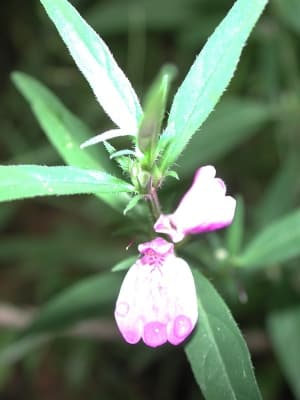
Justicia ladanoides
Justicia ladanoides
Safety & Hazards
None known
Cultivation Details
A plant of low to moderate elevations in the moist tropics. It thrives with an annual rainfall ranging from 1,000 - 2,000 mm, daytime temperatures of 25 - 35°c and night temperatures of 20 - 27°[1]. It does not tolerate low temperatures[1]. It can be found on sandy and loamy soils, but requires rich humus soil and slight shade for optimum growth[1]. The vegetative growth is slow; it takes several weeks after sowing to cover the soil[1]. Flowering occurs at the end of the rainy season and the beginning of the dry season[1]. The production of shoots is concentrated at the base of the plant, 10 - 15 cm above the soil surface, and shoot production continues after flowering[1]. Young plants can be harvested by uprooting when 3 - 5 weeks old, but the main harvest is by cutting[1]. The first cutting is at a height 5 - 6 cm above the ground when the plant height is 20 - 25 cm, or 6 - 7 weeks after planting from seed or cutting[1]. Repeated cuttings promote rapid production of shoots[1]. Harvesting can be carried out at 10-day intervals[1]. A yield of fresh leaves of up to 20 kg per 10 m2 bed may be obtained from repeated harvests over a 4-month period[1]. The ability of the plant to produce leaves from the rainy season until well into the dry season makes it a good source of a regular supply of vegetables for the family[1]. Its potential use as a dry season vegetable should also be investigated[1]. The stigma is receptive at the same time as the anthers are mature. The style exceeds the anthers, and one of the stigma lobes gradually bends down, coming very close to the anthers after some days, thereby gradually increasing the chance of self-pollination. Pollination is effected by insects[1].
Propagation
Seed. The seed remains dormant during the dry season and germinates readily with the onset of rains[1]. The seed may be drilled in rows spaced at 40 - 50 cm. Young seedlings are thinned, allowing 30 - 40 cm between plants in the rows[1]. Spontaneous seedlings can be uprooted and transplanted on vegetable beds[1]. Seed production is difficult because the seeds are scattered when the fruits split open. The fruits can be gathered immediately when the colour changes from green to white, or whole branches with infructescences are harvested and dried[1]. In cultivation it is easiest to take rooted cuttings obtained from the basal parts of the stem[1]. Stem cuttings about 15 cm long can also be planted 30 - 40 cm apart[1]. Cite as: Tropical Plants Database, Ken Fern. tropical.theferns.info. 2026-02-20. <tropical.theferns.info/viewtropical.php?id=Justicia+ladanoides>
Pollinators
Insects, Self
References
- [1]Protabase - Plant Resources of Tropical Africa. — http://www.prota.org ↩︎An excellent on-line database with detailed information on over 3,200 species of useful plants of Africa.
- [2]The Useful Plants of West Tropical Africa. — Burkil. H. M. · Royal Botanic Gardens; Kew. · 1985 - 2004 ↩︎Brief descriptions and details of the uses of over 4,000 plants. A superb, if terse, resource, it is also available electronically on the Web - see http://www.aluka.org/