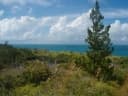
Juniperus bermudiana
Juniperus bermudiana
Safety & Hazards
None known
Cultivation Details
A plant of the subtropical Islands of Bermuda, where the climate is mild and frost-free. It is often grown as an ornamental in the tropics and subtropics[1], and is also surprisingly successful in the temperate zone. In Britain, for example, as well as succeeding in the mildest regions of the country, it is also being grown successfully at Hillier's Arboretum in Hampshire where winter frosts are common and temperatures can occasionally fall to around -8°c[2] Juniperus bermudiana is grown as an ornamental and timber tree outside its native range. Perhaps the biggest planting is in St Helena and on Ascension Island where seed was introduced during the mid-19th century to establish timber tree plantations[3, 4]. Growth during the first 10 years is slow[5]. A dioecious species, both male and female forms need to be grown if fruit and seed are required[1].
Propagation
The seed requires a period of cold stratification. The seed has a hard seedcoat and can be very slow to germinate, requiring a cold period followed by a warm period and then another cold spell, each of 2 - 3 months duration[6, 7]. Soaking the seed for 3 - 6 seconds in boiling water may speed up the germination process[8]. The seed is best sown as soon as it is ripe in a cold frame. Some might germinate in the following spring, though most will take another year. Another possibility is to harvest the seed 'green' (when the embryo has fully formed but before the seedcoat has hardened). The seedlings can be potted up into individual pots when they are large enough to handle. Grow on in pots until large enough, then plant out in early summer. When stored dry, the seed can remain viable for several years[9]. Cuttings of mature wood, 5 - 10cm with a heel, September/early autumn in a cold frame. Plant out in the following autumn[9, 6]. Layering in September/early autumn. Takes 12 months[6]. Cite as: Temperate Plants Database, Ken Fern. temperate.theferns.info. 2026-02-21. <temperate.theferns.info/plant/Juniperus+bermudiana>
Pollinators
Wind
References
- [1]Dominica Botanic Gardens — http://www.da-academy.org/trees_shrubs.html ↩︎An on-line resource, providing top quality pictures and some basic information on various plants being grown at the Botanic Gardens, often including uses and habitat.
- [2]New Trees — Grimshaw J.; Bayton R.; Wilks H. · Kew Publishing; London · 2009 · ISBN 1842461737 ↩︎Provides comprehensive botanical descriptions and horticultural commentary on over 800 tree species that have been introduced to cultivation in recent decades.
- [3]IUCN Red List of Threatened Species — http://www.iucnredlist.org/ ↩︎A list of plants under threat and facing possible extinction, usually with brief details of the threats and information on habitat.
- [4]Global Invasive Species Database — http://www.issg.org/database/welcome/ ↩︎Very detailed information on almost 400 species (with more being added) of plants that have become weeds in areas outside their native range.
- [5]Protabase - Plant Resources of Tropical Africa. — http://www.prota.org ↩︎An excellent on-line database with detailed information on over 3,200 species of useful plants of Africa.
- [6]Propagation of Trees, Shrubs and Conifers. — Sheat. W. G. · MacMillan and Co · 1948 · ISBN - ↩︎A bit dated but a good book on propagation techniques with specific details for a wide range of plants.
- [7]Conifers. — Rushforth. K. · Christopher Helm · 1987 · ISBN 0-7470-2801-X ↩︎Deals with conifers that can be grown outdoors in Britain. Good notes on cultivation and a few bits about plant uses.
- [8]Trees and Shrubs Hardy in Great Britain. Vol 1 - 4 and Supplement. — Bean. W. · Murray · 1981 · ISBN - ↩︎A classic with a wealth of information on the plants, but poor on pictures.
- [9]RHS Dictionary of Plants plus Supplement. 1956 — F. Chittendon. · Oxford University Press · 1951 · ISBN - ↩︎Comprehensive listing of species and how to grow them. Somewhat outdated, it has been replaced in 1992 by a new dictionary (see [ 200 ]).
- [10]Contribution to an evaluation of tree species using the new CITES Listing Criteria — UNEP-WCMC; Cambridge. · 1999 · http://sea.unep-wcmc.org/species/tree_study/ ↩︎A document produced by UNEP World Conservation Monitoring Centre in 1999. It contains fact sheets on more than 200 tree species from around the globe.
- [PFAF]Plants for a Future — pfaf.org ↩︎