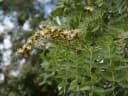
Julbernardia globiflora
Julbernardia globiflora
Safety & Hazards
The root, bark and leaf have been recorded to be toxic: drinking an infusion of the leaf causes vomiting whilst drinking an infusion of the root or bark may cause a person to lose speech, to foam at the mouth and to roll about as if in pain[1]. Infusions of the bark or root have been drunk as ordeal poisons[1].
Cultivation Details
A tree of drier areas in the tropics, being found at elevations from 250 - 2,000 metres. The ares in which it grows usually have a mean average annual rainfall below 1,000 mm, a dry season of 7 - 8 months, and are subject to regular fires[1]. The tree is often found in the wild in drier areas and on poor soils[1]. The tree has an extensive root system, with a maximum recorded lateral distance of 27 metres[1]. Natural regeneration from seed is rare, but trees respond well to coppicing and resprout vigorously after cutting[1]. Trees cut close to the ground (less than 5cm) when coppicing produce less regrowth than plants cut at a height of 1.3 metres[1]. In dry miombo woodland in Zimbabwe the mean stem height of regrowth was 67cm at 1 year; 110cm after 2; 141cm after 3; 247cm after 9; and 517cm after 18 years[1]. Plants only 1.5 metres tall can already produce seed, especially when of coppice origin[1]. Trees often do not fruit yearly[1]. Although many species within the family Fabaceae have a symbiotic relationship with soil bacteria, this species is said to be devoid of such a relationship and therefore does not fix atmospheric nitrogen[2].
Propagation
Seed - germination takes 5 - 25 days, and germination rates of 73% have been recorded under field and laboratory conditions. The germination of seeds stored for a year was only 35%[1]. Under experimental field conditions in Zambia, the seedling mortality rate was about 60% during the first year[1]. Suckers. Cite as: Tropical Plants Database, Ken Fern. tropical.theferns.info. 2026-02-20. <tropical.theferns.info/viewtropical.php?id=Julbernardia+globiflora>
Pollinators
Bees
References
- [1]Protabase - Plant Resources of Tropical Africa. — http://www.prota.org ↩︎An excellent on-line database with detailed information on over 3,200 species of useful plants of Africa.
- [2]Nodulation Plants in GRIN Taxonomy — United States Department of Agriculture · http://www.ars-grin.gov/~sbmljw/cgi-bin/taxnodul.pl?language=en ↩︎An online database listing plants that have either positive or negative reports on root and stem nodulation with nitrogen-fixing bacteria.
- [3]Flora of Tropical East Africa — Beentje H.J. · Royal Botanic Gardens; Kew. · 2002 · http://plants.jstor.org/search?st=396814 ↩︎Available on-line, a modern flora of East Africa.
- [4]African Flowering Plants Database — Conservatoire et Jardin Botaniques. · http://www.ville-ge.ch/musinfo/bd/cjb/africa/recherche.php ↩︎Contains information on over 150,000 plant names (including synonyms) giving a description and habitat, plus a distribution map.