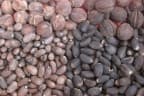
Jatropha curcas
Jatropha curcas
Safety & Hazards
All parts of the plant are extremely purgative and poisonous[1]. The oil from the seed contains a toxin, curcasin[2]. The albumen of the kernel is a poison, toxalbumen cursin, most abundant in the embryo[2]. Another poison, a croton resin, occurs in the seeds and causes redness and pustular eruptions of the skin[2]. The plant is listed as a fish poison[2].
Cultivation Details
As a succulent that sheds its leaves during the dry season, Physic nut is best adapted to arid and semi-arid conditions. The current distribution of the plant shows that introduction has been most successful in drier regions of the tropics[2]. It is very tolerant and thrives under a wide range of climatic and edaphic conditions. It is particularly hardy at medium elevations and in humid zones. It is not sensitive to day length[2]. It succeeds in subtropical to tropical lowland areas, usually found at elevations below 500 metres, but some plants have been known to succeed at elevations up to 1,600 metres[2]. The average annual precipitation of provenance collection sites is from 520 - 2,000mm, however the species survives well in semi-arid regions and has stood several years without rainfall in Cape Verde[2]. Average temperatures of provenance collection sites range from 11 - 28°c[2]. Plants can survive a short, slight frost[2]. Prefers a position in full sun or light, part-day shade[1]. Grows on well-drained soils with good aeration and is well adapted to marginal soils with low nutrient content[2]. On heavy soils, root formation is reduced[2]. Prefers a pH in the range 5.5 - 7.5, tolerating 5 - 8[3]. Established plants are very drought tolerant[2]. Cultivated for medicinal purposes for several hundred years, the plant was distributed all over the world long ago and is now naturalized throughout the tropics and subtropics[4]. Shrubs begin to produce when only 4 - 5 months old, and reach full productivity at about 3 years[2]. Under good rainfall conditions, nursery plants bear fruit after the first rainy season, while directly seeded plants bear for the first time after the 2nd rainy season. With vegetative propagation, the first seed yield is higher. At least 2 - 3 tonnes of seeds per hectare can be achieved in semi-arid areas[2]. Most plants are monoecious but rarely, there are hermaphroditic flowers which can be self-pollinating[2]. The female flowers are 4 - 5 times more numerous than the male ones[2]. Fruit development needs 90 days from flowering until seeds mature[2]. The tree has a productive life of 40 - 50 years without necessitating replanting or tending[2].
Propagation
Seed. Use of fresh seeds improves germination[2]. Intervals of alternate pre-soaking and drying, or the partial removal of the testa, are more successful than pre-soaking alone[2]. With good moisture conditions, germination takes 10 days. The seed shell splits, the radicle emerges and 4 small peripheral roots are formed. Soon after development of the first leaves, the cotyledons wither and fall off[2]. Seeds are oily and do not store for long. Seeds older than 15 months show viability below 50%. High levels of viability and low levels of germination shortly after harvest indicate innate (primary) dormancy[2]. Cuttings of half-ripe wood. Cuttings can be planted directly in situ, a practice often carried out when establishing a hedge[2]. Cite as: Tropical Plants Database, Ken Fern. tropical.theferns.info. 2026-02-20. <tropical.theferns.info/viewtropical.php?id=Jatropha+curcas>
Pollinators
Insects
References
- [1]The New RHS Dictionary of Gardening. 1992. — Huxley. A. · MacMillan Press · 1992 · ISBN 0-333-47494-5 ↩︎Excellent and very comprehensive, though it contains a number of silly mistakes. Readable yet also very detailed.
- [2]World Agroforesty Centre — http://www.worldagroforestry.org/ ↩︎An excellent online database of a huge range of trees giving very good information on each plant - its uses, ecology, identity, propagation, pests etc.
- [3]Ecocrop — http://ecocrop.fao.org/ecocrop/srv/en/home ↩︎Basic information on a wide range of useful plants, plus details of environmental needs where available.
- [4]Protabase - Plant Resources of Tropical Africa. — http://www.prota.org ↩︎An excellent on-line database with detailed information on over 3,200 species of useful plants of Africa.
- [5]Dictionary of Economic Plants. — Uphof. J. C. Th. · Weinheim · 1959 · ISBN - ↩︎An excellent and very comprehensive guide but it only gives very short descriptions of the uses without any details of how to utilize the plants. Not for the casual reader.
- [6]Plants and People of Nepal — Manandhar. N. P. · Timber Press. Oregon. · 2002 · ISBN 0-88192-527-6 ↩︎Excellent book, covering over 1,500 species of useful plants from Nepal together with information on the geography and peoples of Nepal. Good descriptions of the plants with terse notes on their uses.
- [7]The Useful Plants of the Island of Guam — Safford W.E. · Smithsonian Institute; Washington. · 1905 · http://www.biodiversitylibrary.org/ ↩︎A very comprehensive, if rather dated, guide to the plants of Guam. It can be downloaded from the Internet.
- [8]Medicinal Plants of the Guianas — DeFilipps, R. A.; Maina, S. L.; & Crepin, J. · Smithsonian Museum · http://botany.si.edu/bdg/medicinal/index.html ↩︎A down-loadable PDF document of a book in pre-publication awaiting illustration. An excellent, if rather terse, guide to the traditional medicinal uses of the plants of the region
- [PFAF]Plants for a Future — pfaf.org ↩︎