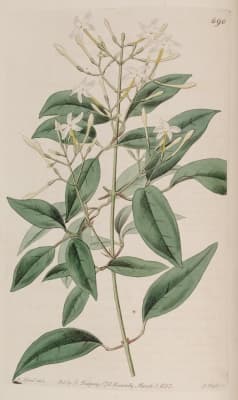
Jasminum lanceolaria
Jasminum lanceolaria
Safety & Hazards
None known
Cultivation Details
Members of this genus generally succeed in full sun or partial shade, preferring a fertile, humus-rich, moist but well-drained soil[1].
Propagation
Seed - it does not require pre-treatment and is best sown in a partially shaded position as soon as it is ripe[2]. Cuttings 12 - 20cm long should be taken from terminal shoots; treatment with a root stimulator increases the strike rate[3]. Semi-ripe cuttings, 8cm long, places in a sandy medium, usually root within 4 weeks[2]. Cuttings taken from shoot tips have given better results than semi-ripe cuttings. They are usually treated with a fungicide, placed in prepared planting holes and watered[3]. Layering in the field is done with one-year-old shoots; a slanting cut is made approximately half-way through the shoot some 50cm from the end; the cut is buried about 10 - 15cm deep with the top remaining above ground. After about 4 - 6 months the rooted layers can be separated from the parent plant and transplanted[3]. Cite as: Tropical Plants Database, Ken Fern. tropical.theferns.info. 2026-02-20. <tropical.theferns.info/viewtropical.php?id=Jasminum+lanceolaria>
Pollinators
Insects
References
- [1]Encyclopedia of Tropical Plants - Identification and Cultivation of over 3,000 Tropical Plants — Ahmed Fayaz · Firefly Books Ltd.; New Zealand · 2011 · ISBN 978-1-55407-489 ↩︎A good photograph and terse but detailed information for over 3,000 species of tropical plants. An excellent reference.
- [2]Desert Tropicals — http://www.desert-tropicals.com/ ↩︎The main focus of the site is succulent plants, but it also contains information on a wide range of other species. Usually at least one good photograph, plus basic information about the plant and its cultivation.
- [3]Plant Resources of Southeast Asia — http://proseanet.org/ ↩︎Lots of information on the uses of the plants of SE Asia.
- [4]Flora of China — Missouri Botanical Garden Press; St. Louis. · 1994 · http://flora.huh.harvard.edu/china/ ↩︎An excellent, comprehensive resource in 25 volumes. In addition to the botanical information the flora also gives basic information on habitat and some uses. An on-line version is also available.
- [5]Cornucopia II — Facciola. S. · Kampong Publications, California. · 1998 · ISBN 0-9628087-2-5 ↩︎The second edition of an excellent guide to the edible uses of plants, though it does not give any details of cultivation etc.