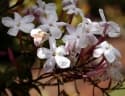
Jasminum grandiflorum
Jasminum grandiflorum
Safety & Hazards
None known
Cultivation Details
Jasminum grandiflorum can be grown from the warm temperate to the tropical zones. When grown commercially, plantations are usually below elevations of 500 metres[1]. The plant is day-neutral, and floral initiation is promoted by high day and low night temperatures. Some cultivars can resist at least some frost[1]. Grows best in a sunny position, growth and flowering being depressed by shade[1]. Preferring warm sunny conditions with adequate soil moisture, the plant can withstand short periods of very high temperatures[1]. Growth and flowering are depressed by low daytime temperatures and cool wet conditions[1]. Some cultivars are fairly drought tolerant, although flowering is strongly reduced by moisture stress[1]. Almost any well-drained soil is suitable, but sandy clays or loams with a pH between 6 - 8 are preferred[1]. Marshy, waterlogged or very stony soils should be avoided, as should saline soils[1]. The plant grows slowly for the first 2 years after planting, but first flowering starts at the age of 6 months. In the 3rd and following years flowering is profuse[1]. Mature plants flower for 7 - 9 months per year in warm regions, 4 - 6 months in temperate regions[1]. Seed set is usually very low and pollen sterility frequently above 75%[1]. Flowers open early in the morning and oil content decreases considerably after 10 a.m. In Europe, flowers contain substantially more essential oil in August and September than in July and October[1]. Jasmine plantations usually remain productive for 10 - 15 years but perhaps much longer if well-managed[1]. Jasminum grandiflorum is a complex species with wild and cultivated populations[1]. Jasmine flowers are picked manually between dawn and 10 a.m., during the hot season in India even between 3 - 8 a.m. Preferably only half-opened and fresh fully opened flowers must be picked, not buds or old (yellowish) flowers, as these will depress the quality of the essential oil. Although rain makes the flowers almost useless, picking flowers in the rain should continue, to promote further flowering[1]. An experienced picker can harvest 0.5 kg flowers per hour, but the pickers are usually young women and children, who achieve 2 kg in 5 hours[1]. Annual flower yield of jasmine varies from 5.5 - 12.5 t/ha, on average 5 - 8 t/ha. Modern commercial plantations average 8 - 10 t/ha. In Java, production is highest during the rainy season (30 kg/ha per day), and lowest during the dry season (4 kg/ha per day). Concrete yield is about 0.1%; up to 0.3% is reported from India. As an approximate guide, 1000 kg flowers yield 1 kg concrete when solvent extracted, half of this as absolute[1]. Jasmine flowers must be quickly processed, since delay substantially reduces essential oil content. Flowers should be kept shaded and cool between picking and processing and the processing facility should be close to the plantation. Freshly picked flowers can be stored in polythene bags at 15°c without loss of yield, quality or odour[1]. Jasmine oil can be obtained from flowers by steam distillation but the yield is very low. Jasmine concrete is obtained from flowers, formerly by enfleurage, currently by solvent extraction. In solvent extraction, flowers are washed up to 3 times with petroleum ether or, preferably, with hydrocarbon-free food-grade hexane; the extract is then distilled to remove the solvent, resulting in the concrete. Concrete is usually produced at the plantation, but absolute is produced where convenient, often in another country[1].
Propagation
Seed - although it can be propagated by seed, seed production is usually low, viability is seldom above 50% and seed remains viable for 6 months only[1]. Cuttings 12 - 20cm long should be taken from terminal shoots; treatment with a root stimulator increases the strike rate[1]. Cuttings taken from shoot tips have given better results than semi-ripe cuttings. They are usually treated with a fungicide, placed in prepared planting holes and watered[1]. Layering in the field is done with one-year-old shoots; a slanting cut is made approximately half-way through the shoot some 50cm from the end; the cut is buried about 10 - 15cm deep with the top remaining above ground. After about 4 - 6 months the rooted layers can be separated from the parent plant and transplanted[1]. In warm temperate areas the plant is grafted on 2 - 3-year-old rootstocks of Jasminum officinale to give protection against frost. In warmer regions grafting is not needed[1]. Cite as: Tropical Plants Database, Ken Fern. tropical.theferns.info. 2026-02-20. <tropical.theferns.info/viewtropical.php?id=Jasminum+grandiflorum>
Pollinators
Insects
References
- [1]Plant Resources of Southeast Asia — http://proseanet.org/ ↩︎Lots of information on the uses of the plants of SE Asia.
- [2]Medicinal Plants of the Guianas — DeFilipps, R. A.; Maina, S. L.; & Crepin, J. · Smithsonian Museum · http://botany.si.edu/bdg/medicinal/index.html ↩︎A down-loadable PDF document of a book in pre-publication awaiting illustration. An excellent, if rather terse, guide to the traditional medicinal uses of the plants of the region
- [3]Glossary of Indian Medicinal Plants (Including the Supplement). — Chopra. R. N., Nayar. S. L. and Chopra. I. C. · Council of Scientific and Industrial Research, New Delhi. · 1986 · ISBN - ↩︎Very terse details of medicinal uses of plants with a wide range of references and details of research into the plants chemistry. Not for the casual reader.
- [PFAF]Plants for a Future — pfaf.org ↩︎