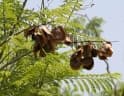
Jacaranda mimosifolia
Jacaranda mimosifolia
Safety & Hazards
None known
Cultivation Details
A plant of the moist tropics and subtropics, where it is found at elevations from 500 - 2,400 metres. It grows best in areas where annual daytime temperatures are within the range 20 - 34°c, but can tolerate 10 - 38°c[1]. Young growth is intolerant of frost, but older trees can sometimes withstand occasional short-lived lows to -5°c[2, 3, 1]. It prefers a mean annual rainfall in the range 800 - 1,400mm, but tolerates 650 - 1,800mm[1]. Prefers a sunny position[1]. Grows best on well-drained sandy loam soils, although it will also survive on poor shallow soils[2]. It does not tolerate waterlogged or clay soils[2]. Prefers a pH in the range 6.5 - 7.5, tolerating 6 - 8.5[1]. Tolerates salt-laden winds[1]. Established plants are drought tolerant[1]. Often grown as an ornamental in the tropics and subtropics, the plant can escape from cultivation by means of its wind-dispersed seed and become naturalized. The spreading growth habit and the dense foliage shade out native plants and prevent their regeneration[4]. A fast growing tree that resprouts easily if damaged[4].
Propagation
Seed - no pre-treatment is required[2]. The seed should be sown fresh for best germination results - fresh seed soaked in water for 24 hours takes 10 - 12 days for germination, which continues for up to 2 months[2]. Germination rate is 50 - 92%[2]. Planting should be from container stock during cool weather; 8 - 10 months should elapse before plants can be transplanted to the field[2]. The tree is a prolific seeder. Viability is maintained for at least 12 months in open storage at room temperature[2]. Cuttings of semi-ripe wood with a heel, rooted in sand[5]. Keep shaded until well rooted[5]. The plants can be raised from branch cuttings. Cite as: Tropical Plants Database, Ken Fern. tropical.theferns.info. 2026-02-20. <tropical.theferns.info/viewtropical.php?id=Jacaranda+mimosifolia>
Pollinators
Bees, Birds
References
- [1]Ecocrop — http://ecocrop.fao.org/ecocrop/srv/en/home ↩︎Basic information on a wide range of useful plants, plus details of environmental needs where available.
- [2]World Agroforesty Centre — http://www.worldagroforestry.org/ ↩︎An excellent online database of a huge range of trees giving very good information on each plant - its uses, ecology, identity, propagation, pests etc.
- [3]KemperCentreForHomeGardeningPlantFinder — Missouri Botanical Garden · http://www.mobot.org/gardeninghelp/plantfinder/ ↩︎Basic cultivation details, plant uses, habitat etc for several thousand species of plants, mainly from the temperate zone.
- [4]Pacific Island Ecosystems at Risk — http://www.hear.org/pier/scientificnames/index.html ↩︎A very good website detailing weed species that have been introduced into the Pacific Islands.
- [5]The New RHS Dictionary of Gardening. 1992. — Huxley. A. · MacMillan Press · 1992 · ISBN 0-333-47494-5 ↩︎Excellent and very comprehensive, though it contains a number of silly mistakes. Readable yet also very detailed.
- [6]IUCN Red List of Threatened Species — http://www.iucnredlist.org/ ↩︎A list of plants under threat and facing possible extinction, usually with brief details of the threats and information on habitat.
- [7]Bignoniaceae: Part II (Tribe Tecomeae) — Gentry A.H. · The New York Botanical Garden, New York · 1992 · ISBN 0-89327-368-6 ↩︎
- [8]Medicinal Plants of Brazil — Mors W.B.; Rizzini C.T.; Pereira N.A. · Reference Publications; Michigan. · 2000 · ISBN 0-917256-42-5 ↩︎An extremely concise book, listing approximately 1,500 species and varieties of plants with their botanical name, common name in Brazil, regions in Brazil where the plant is found, a brief list of uses and any medically active compounds in the plant.
- [9]Diccionario das Plantas Uteis do Brasil — Correa M.P. · Imprensa Nacional; Rio de Janeiro · 1926 ↩︎A massive work in 6 volumes giving details of the various uses of Brazilian plants.
- [10]CosIng — http://ec.europa.eu/growth/tools-databases/cosing/ ↩︎CosIng is the European Commission database for information on cosmetic substances and ingredients.