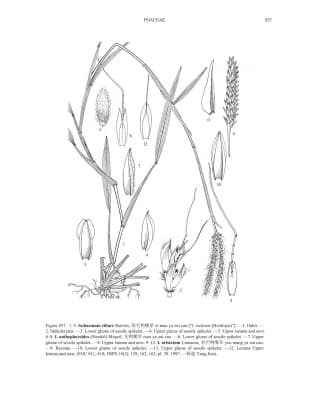
Ischaemum ciliare
Ischaemum ciliare
Safety & Hazards
None known
Cultivation Details
A plant of lowland tropical areas, rarely found at elevations above 600 metres. It has an optimal growing temperature between 30 - 35°c and is intolerant of frost. It is adapted to a wide range of rainfall regimes, including waterlogged areas in the wet tropics receiving up to 7,000mm annual rainfall per year, and to seasonally dry monsoonal areas of India[1, 2]. The plant has been reported as having some shade tolerance, remaining productive and persistent with light transmission as low as 40%, performing well under coconuts[1, 2]. It is adapted across a wide range of soil textures (except on sandy or coralline soils), fertility levels and tolerates a pH in the range 4.5 - 7 or 8. It is especially useful on very acid, low fertility soils with high aluminium content, and can tolerate poor drainage and some salinity[2]. It responds well to applications of fertilizer on poor soils[1]. The plant is not tolerant of drought, but has good flood tolerance[2]. The plant is an opportunistic invader of open or disturbed habitats[1]. It can spread by means of its stolons, pieces of which may be transferred between cloven hooves[2].
Propagation
Seed - it shows dormancy for up to 6 months after harvest, with germination continuing to improve for up to 10 months under good storage conditions. Seed can be sown in situ. Seedlings are vigorous[2]. Cuttings of the stolons can be broadcast onto the soil surface and disced in, or planted on a 30cm grid[2]. Cite as: Tropical Plants Database, Ken Fern. tropical.theferns.info. 2026-02-20. <tropical.theferns.info/viewtropical.php?id=Ischaemum+ciliare>
Pollinators
Wind
References
- [1]Plant Resources of Southeast Asia — http://proseanet.org/ ↩︎Lots of information on the uses of the plants of SE Asia.
- [2]Tropical Forages — http://www.tropicalforages.info/key/Forages/Media/Html/index.htm ↩︎Mainly focussed on forage plants, the site gives a lot of information on the plant, with a good botanical description, details of cultivation, plant uses and a good selection of photographs.
- [3]Annals of the Missouri Botanical Garden. Volume 55 — Missouri Botanical Garden · 1968 · http://www.biodiversitylibrary.org ↩︎Contains, amongst other things, a taxonomic treatment of the Phytolaccaceae and part of the flora of Panama. Can be downloaded from the Internet.