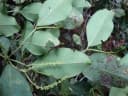
Irvingia gabonensis
Irvingia gabonensis
Safety & Hazards
None known
Cultivation Details
A plant of the moist to wet, lowland tropics, where it is found at elevations from 200 - 500 metres. It grows best in areas where annual daytime temperatures are within the range 25 - 32°c, but can tolerate 20 - 38°c[1]. It prefers a mean annual rainfall in the range 1,500 - 3,000mm, but tolerates 1,200 - 3,300mm[1]. Prefers a sunny position, tolerating light shade[1]. It does not have any particular soil preference, though it grows well in well-drained, acidic soils[2]. The plant is restricted in the wild to fairly wet, well-drained loamy to clayey soils[3]. Prefers a pH in the range 5 - 7, tolerating 4.5 - 7.5[1]. Growth in young plants is very slow; later it becomes moderately fast[4]. The fruits are mostly gathered from the ground around each tree, or are harvested by climbing when the tree is not too tall. The next step consists of extracting kernels from seed, which is split in halves with a cutlass, and the kernel is removed with the help of a knife. The kernels are then dried in the sun or on bamboo drying racks over the fireplace in the kitchen[4]. Twelve year-old trees in Nigeria have yielded 1060 fruits (180 kilos) per tree, but in drier areas yields are much lower. Good kernel yields are about 100 kilos per tree per year[4]. Trees are not resistant to fire[4]. A number of different forms are recognised in Africa. These differences are not always recognized by botanists:- In Liberia there are two: one is small-leaved with inedible seeds, and the other larger-leafed with edible seeds[5]. In Nigeria: var. Gabonensis has sweet edible fruit-pulp, whilst var. Excelsa has bitter inedible pulp but is slimy and is added to soup for this quality[5]. Modern treatments distinguish these two forms as distinct species, var excelsa being separated as Irvingia excelsa Mildbr.[PFAF]. In Lower Dahomey a variety with a thick edible pulp is cultivated[5]. In Ivory Coast large-leaved and small-leaved forms are given separate vernacular names, the former being considered inedible[5].
Propagation
Seed - it has a short period of viability and so should be sown as soon as it is ripe. Germination takes more than 14 days and the seed should first be extracted from the fruit and then dried for at least 2 days prior to sowing. A germination rate of 80% can be reached in this way[4]. Cite as: Tropical Plants Database, Ken Fern. tropical.theferns.info. 2026-02-20. <tropical.theferns.info/viewtropical.php?id=Irvingia+gabonensis>
Pollinators
Insects
References
- [1]Ecocrop — http://ecocrop.fao.org/ecocrop/srv/en/home ↩︎Basic information on a wide range of useful plants, plus details of environmental needs where available.
- [2]World Agroforesty Centre — http://www.worldagroforestry.org/ ↩︎An excellent online database of a huge range of trees giving very good information on each plant - its uses, ecology, identity, propagation, pests etc.
- [3]IUCN Red List of Threatened Species — http://www.iucnredlist.org/ ↩︎A list of plants under threat and facing possible extinction, usually with brief details of the threats and information on habitat.
- [4]Protabase - Plant Resources of Tropical Africa. — http://www.prota.org ↩︎An excellent on-line database with detailed information on over 3,200 species of useful plants of Africa.
- [5]The Useful Plants of West Tropical Africa. — Burkil. H. M. · Royal Botanic Gardens; Kew. · 1985 - 2004 ↩︎Brief descriptions and details of the uses of over 4,000 plants. A superb, if terse, resource, it is also available electronically on the Web - see http://www.aluka.org/
- [6]Mansfeld's Database of Agricultural and Horticultural Plants — http://mansfeld.ipk-gatersleben.de/pls/htmldb_pgrc/f?p=185:3:4292127278597336 ↩︎Terse details of a huge range of useful plants.
- [7]Cornucopia II — Facciola. S. · Kampong Publications, California. · 1998 · ISBN 0-9628087-2-5 ↩︎The second edition of an excellent guide to the edible uses of plants, though it does not give any details of cultivation etc.
- [8]Nuts. — Howes. F. N. · Faber · 1948 · ISBN - ↩︎Rather old but still a masterpiece. Has sections on tropical and temperate plants with edible nuts plus a section on nut plants in Britain. Very readable.
- [9]Irvingiaceae: Flora of the World Part 1: 1 - 25 — Harris. D.J. · Australian Biological Resources Study; Canberra · 1999 · ISBN 0 642 56800 6 ↩︎A monograph of the Irvingiaceae which includes some plant uses.
- [10]Dictionary of Economic Plants. — Uphof. J. C. Th. · Weinheim · 1959 · ISBN - ↩︎An excellent and very comprehensive guide but it only gives very short descriptions of the uses without any details of how to utilize the plants. Not for the casual reader.
- [PFAF]Plants for a Future — pfaf.org ↩︎