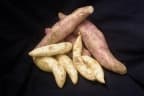
Ipomoea batatas
Ipomoea batatas
Safety & Hazards
None known
Cultivation Details
Sweet potato is a plant of the tropics, but can also be grown in the subtropics and, if there is a sufficient growing season of 110 - 170 days, as an annual crop in warmer parts of the temperate zone. It is grown in the tropics at elevations up to 2,800 metres. It grows best in areas where annual daytime temperatures are within the range 18 - 28°c, but can tolerate 10 - 38°c[1]. When dormant, the roots can survive temperatures down to about 1°c, but young growth can be killed by temperatures of 5°c[1]. It prefers a mean annual rainfall in the range 750 - 2,000mm, but tolerates 350 - 5,000mm[1]. An easily grown plant, it prefers a well-drained, sandy loam soil and requires a sunny position[2, 3]. Ample potash in the soil is essential for a good crop[3]. Prefers a pH in the range 5 - 7, tolerating 4 - 8.7[1]. A low humidity as the plants reach maturity is beneficial[2]. Plants grow very vigorously in the tropics. They have escaped from cultivation in some areas and become invasive[4, 5]. Unlike many root crops, the sweet potato begins to store starch at an early age, making early harvests possible[6]. It is one of the most efficient plants to capture the energy of the sun as calories[6]. The plant can mature a crop within 2 months in tropical areas, though at least three months are required in sub-tropical regions[3]. Optimum yields vary from 17.5 - 27.5 tonnes per hectare depending on the cultivar and growing conditions, while average yields are 5 tonnes per hectare in Africa, 10 tonnes in South America and 16 tonnes in Asia. The world highest production yield at 80 tonnes has been obtained in Israel[1]. A short-day plant, it requires less than 11 hours of sunlight per day to initiate flowering[2]. However, day length variation appears to have little effect upon tuber production[2].
Propagation
Pre-soak the seed for 12 hours in warm water, or scarify the seed, and sow in individual pots in a greenhouse in early spring. The seed usually germinates in 1 - 3 weeks at 22°c. Plants are extremely resentful of root disturbance, even when they are quite small, and should be potted up almost as soon as they germinate. Grow them on in the greenhouse for at least their first winter then plant them out into their permanent positions in late spring or early summer, after the last expected frosts. Seedlings can be very variable and are likely to be less productive than vegetatively produced plants[2]. Stem cuttings obtained from terminal shoots[2]. Remove the lower leaves and insert the cuttings to half their depth in individual pots. Cite as: Temperate Plants Database, Ken Fern. temperate.theferns.info. 2026-02-21. <temperate.theferns.info/plant/Ipomoea+batatas>
Pollinators
Data unavailable
References
- [1]Ecocrop — http://ecocrop.fao.org/ecocrop/srv/en/home ↩︎Basic information on a wide range of useful plants, plus details of environmental needs where available.
- [2]The New RHS Dictionary of Gardening. 1992. — Huxley. A. · MacMillan Press · 1992 · ISBN 0-333-47494-5 ↩︎Excellent and very comprehensive, though it contains a number of silly mistakes. Readable yet also very detailed.
- [3]Vegetables — Phillips. R. & Rix. M. · Macmillan Reference Books, London. · 1995 · ISBN 0 333 62640 0 ↩︎Excellent and easily read book with good information and an excellent collection of photos of vegetables from around the world, including many unusual species.
- [4]Tropical Food Gardens — Norrington. L. · Bloomings Books (Melbourne) · 2001 · ISBN 1-876473-41-x ↩︎Excellent little book giving some basic information on a range of plants.
- [5]Pacific Island Ecosystems at Risk — http://www.hear.org/pier/scientificnames/index.html ↩︎A very good website detailing weed species that have been introduced into the Pacific Islands.
- [6]Edible Leaves of the Tropics — Martin. F. W.; Ruberte. R. M. & Meitzner. L. S. · Echo. USA. · 1998 · ISBN 0-9653360-1-8 ↩︎A terse guide, giving reasonable detail on the more common leaf crops and brief information on a wide range of lesser known plants.
- [7]Plants and People of Nepal — Manandhar. N. P. · Timber Press. Oregon. · 2002 · ISBN 0-88192-527-6 ↩︎Excellent book, covering over 1,500 species of useful plants from Nepal together with information on the geography and peoples of Nepal. Good descriptions of the plants with terse notes on their uses.
- [8]Cornucopia II — Facciola. S. · Kampong Publications, California. · 1998 · ISBN 0-9628087-2-5 ↩︎The second edition of an excellent guide to the edible uses of plants, though it does not give any details of cultivation etc.
- [9]Medicinal Plants of the Guianas — DeFilipps, R. A.; Maina, S. L.; & Crepin, J. · Smithsonian Museum · http://botany.si.edu/bdg/medicinal/index.html ↩︎A down-loadable PDF document of a book in pre-publication awaiting illustration. An excellent, if rather terse, guide to the traditional medicinal uses of the plants of the region
- [PFAF]Plants for a Future — pfaf.org ↩︎