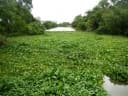
Ipomoea aquatica
Ipomoea aquatica
Safety & Hazards
Accumulation of heavy metals in the plant has been reported in Asia, mainly because the plants are often grown in polluted water[1].
Cultivation Details
Swamp morning glory is a plant of the moist to wet, lowland tropics, where it is found at elevations up to 1,000 metres. It grows best in areas where annual daytime temperatures are within the range 15 - 35°c, but can tolerate 10 - 40°c[2]. It prefers a mean annual rainfall in the range 2,000 - 2,500mm, but tolerates 700 - 4,200mm[2]. Plants grow well in full sun[3]. A very easy plant to grow, it succeeds in bathtubs, ponds and still water[3]. Succeeds in a wide range of soils, including heavy clays[4]. Best leaf production comes from plants grown in soils rich in organic matter[5]. Prefers a pH in the range 5 - 7, tolerating 4.3 - 7.5[2]. The plant is widespread as a swamp weed in all tropical and many subtropical lowland areas. It is a declared aquatic or terrestrial noxious weed in the south-eastern United States[1]. A very fast-growing plant, it starts developing lateral branches from cotyledonary buds 2 - 3 weeks after sowing. Thereafter the main axis and both laterals each produce about one leaf every 2 - 3 days[5, 1]. Cultivars selected for once-over harvest or uprooting have retarded branching or almost no branching. Their harvest takes place 21 - 30 days after sowing[3, 1]. Cut and come again harvesting of vegetatively propagated plants or wild plants can start about one month after plant establishment[1]. Flowering commences after 2 - 5 months, but the plant continues to form new leaves and branches[1]. Swamp morning glory is a quantitative short-day plant, early flowering being induced by short days of less than 12 hours. Flowering is also stimulated by drought[1]. There are some named varieties[6]. Two main forms exist in cultivation:- A short-lived perennial form grows in very wet soils and water (it has been named Ipomoea aquatica aquatica by some authorities). This form can produce yields ofup to 90 tonnes per hectare in Thailand[4]. An annual creeping form tolerates drier conditions (this has been named Ipomoea aquatica reptans)[4]. Under dryland cultivation, yields per crop can range from 7 - 30 tonnes per hectare, averaging 20 tonnes. In theory one crop can be produced every month leading to a potential yield of around 240 tonnes per hectare in a year[1] produce.
Propagation
Seed - sow in situ in moist to wet soil[4]. Only the annual form is usually propagated this way[4]. Germination rates of local cultivars are often low (less than 60%) because of hard-seededness induced by long storage. Reliable seed companies supply improved cultivars with a high (in excess of 80%) germination percentage. The seeds do not germinate well at temperatures lower than 25°c[1]. Cuttings of young shoots at any time of the year. The shoots readily produce roots, even whilst still on the parent plant[4]. Cite as: Tropical Plants Database, Ken Fern. tropical.theferns.info. 2026-02-20. <tropical.theferns.info/viewtropical.php?id=Ipomoea+aquatica>
Pollinators
Self, Bees, Butterflies
References
- [1]Protabase - Plant Resources of Tropical Africa. — http://www.prota.org ↩︎An excellent on-line database with detailed information on over 3,200 species of useful plants of Africa.
- [2]Ecocrop — http://ecocrop.fao.org/ecocrop/srv/en/home ↩︎Basic information on a wide range of useful plants, plus details of environmental needs where available.
- [3]Tropical Food Gardens — Norrington. L. · Bloomings Books (Melbourne) · 2001 · ISBN 1-876473-41-x ↩︎Excellent little book giving some basic information on a range of plants.
- [4]Vegetables in the Tropics — Tindall. H. D. · MacMillan, Oxford. · 1983 · ISBN 0-333-24268-8 ↩︎An excellent, in-depth look at the main vegetable crops that can be grown in the Tropics, plus many less well-known plants.
- [5]Edible Leaves of the Tropics — Martin. F. W.; Ruberte. R. M. & Meitzner. L. S. · Echo. USA. · 1998 · ISBN 0-9653360-1-8 ↩︎A terse guide, giving reasonable detail on the more common leaf crops and brief information on a wide range of lesser known plants.
- [6]Cornucopia II — Facciola. S. · Kampong Publications, California. · 1998 · ISBN 0-9628087-2-5 ↩︎The second edition of an excellent guide to the edible uses of plants, though it does not give any details of cultivation etc.
- [7]Plant Resources of Southeast Asia — http://proseanet.org/ ↩︎Lots of information on the uses of the plants of SE Asia.
- [8]Hedges and Screens. — Shepherd. F.W. · Royal Horticultural Society. · 1974 · ISBN 0900629649 ↩︎A small but informative booklet giving details of all the hedging plants being grown in the R.H.S. gardens at Wisley in Surrey.
- [9]Plants and People of Nepal — Manandhar. N. P. · Timber Press. Oregon. · 2002 · ISBN 0-88192-527-6 ↩︎Excellent book, covering over 1,500 species of useful plants from Nepal together with information on the geography and peoples of Nepal. Good descriptions of the plants with terse notes on their uses.
- [10]Medicinal Plants of the Guianas — DeFilipps, R. A.; Maina, S. L.; & Crepin, J. · Smithsonian Museum · http://botany.si.edu/bdg/medicinal/index.html ↩︎A down-loadable PDF document of a book in pre-publication awaiting illustration. An excellent, if rather terse, guide to the traditional medicinal uses of the plants of the region