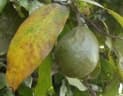
Inocarpus fagifer
Inocarpus fagifer
Safety & Hazards
None known
Cultivation Details
A plant of hot, humid, tropical lowlands at elevations below 500 metres[1]. It is found in areas where the mean annual rainfall ranges from 1,500 - 4,300mm and there is only a small or no dry season[2]. The mean annual temperature is around 27°c, with the hottest month ranging from 29.4 - 34.5°c and the coolest month 20 - 23°c[2]. Plants are fairly shade tolerant, although heavy shade can reduce yields of seeds[2]. The plant succeeds in a wide range of soils that include highly calcareous and saline soils and poorly drained seasonal to permanently waterlogged valleys, swamps, and marshes. It occurs in soils with medium to very low fertility rating. It can grow in mildly acidic to very alkaline coastal soils with a pH up to 14[2]. It has medium to high tolerance of steady and strong winds and is windfirm due to a strong lateral root system including buttresses[2]. The plant has a moderate to fast rate of growth, with annual increases in height when young of up to 2 metres per year[2]. Trees can commence flowering when around 3 - 5 years old[2]. Yields of up to 75 kilos of fruits per tree per annum can be obtained from trees 25 or more years old[2]. Trees can live for 80 - 90 years[2]. The tree responds well to coppicing[2]. Although many species within the family Fabaceae have a symbiotic relationship with soil bacteria, this species is said to be devoid of such a relationship and therefore does not fix atmospheric nitrogen[3].
Propagation
Seed - it does not tolerate dessication and has a very short viability of a few weeks. The seeds are large and can be sown directly into their permanent positions or into deep, individdual containers. Young plants require shade from strong sun. Germination can take place within 7 days, with almost 100% of the seeds sprouting. Nursery sown seeds can be transplanted to their permanent positions about 2 months after germinating, when about 20 - 30cm tall[2]. Single-node cuttings, taken from stems of the current year's growth, can root within 14 days, with almost 100% success rate[2]. Cite as: Tropical Plants Database, Ken Fern. tropical.theferns.info. 2026-02-20. <tropical.theferns.info/viewtropical.php?id=Inocarpus+fagifer>
Pollinators
Data unavailable
References
- [1]Perennial Edible Fruits of the Tropics : an Inventory — Martin, F. W.; Campbell, C. W.; Rubertbe, R. M. · U.S. Dept. of Agriculture, Agricultural Research Service · 1987 ↩︎A booklet giving terse details of almost 300 species of edible fruits, plus regional lists of Botanical and Common names for over 2,500 less well-known edible fruits of the tropics.
- [2]Traditional Trees of Pacific Islands — Elevitch. Craig. R. (Editor) · Permanent Agriculture Resources, Hawaii · 2006 · ISBN 0970254458 ↩︎Beautifully produced book with superb photos and detailed information on over 50 species of useful plants of the Pacific Islands.
- [3]Nodulation Plants in GRIN Taxonomy — United States Department of Agriculture · http://www.ars-grin.gov/~sbmljw/cgi-bin/taxnodul.pl?language=en ↩︎An online database listing plants that have either positive or negative reports on root and stem nodulation with nitrogen-fixing bacteria.
- [4]Medicinal Plants in the South Pacific — WHO Regional Publications, Manilla. · 1998 · ISBN 92-9061-118-9 ↩︎Excellent guide to 102 medicinal herbs of the Pacific Islands, with photographs of each plant and details of their constituents, biological activities and traditional uses. A description of each plant, together with habitat and distribution is given.
- [5]Dictionary of Economic Plants. — Uphof. J. C. Th. · Weinheim · 1959 · ISBN - ↩︎An excellent and very comprehensive guide but it only gives very short descriptions of the uses without any details of how to utilize the plants. Not for the casual reader.
- [6]Nuts. — Howes. F. N. · Faber · 1948 · ISBN - ↩︎Rather old but still a masterpiece. Has sections on tropical and temperate plants with edible nuts plus a section on nut plants in Britain. Very readable.
- [7]South Pacific Indigenous Nuts. ACIAR Proceedings No 69 — Stevens M.L.; Bourke R.M. & Evans B.R. · Australian Centre for International Agricultural Research; Canbe · 1996 · ISBN 1 86320 175 0 ↩︎Proceedings of a workshop held from 31 October to 4 November 1994 at Le Lagon Resort, Port Vila, Vanuatu.
- [8]Cornucopia II — Facciola. S. · Kampong Publications, California. · 1998 · ISBN 0-9628087-2-5 ↩︎The second edition of an excellent guide to the edible uses of plants, though it does not give any details of cultivation etc.
- [9]The Leguminosae; A Source Book of Characteristics, Uses and Nodulation — Allen O.N.; Allen E.K. · University of Wisconsin · 1981 · ISBN 0-333-32221-5 ↩︎An amazing and comprehensive work, giving a brief guide to the many genera of the family Fabaceae and also the principle uses of the genus.
- [10]Medicinal Plants in Papua New Guinea — World Health Organisation · 2009 · ISBN 978-92-9061-249-0 ↩︎Traditional medicinal uses of 126 species from Papua New Guinea, including information on modern research into the plants.