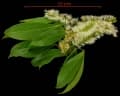
Inga marginata
Inga marginata
Safety & Hazards
None known
Cultivation Details
Succeeds in a variety of habitats, elevations and climates from the subtropics to the tropics[1]. Prefers a sunny position, though it is sometimes found in deeper shade[1]. A fast-growing species[1]. This species has a symbiotic relationship with certain soil bacteria, these bacteria form nodules on the roots and fix atmospheric nitrogen. Some of this nitrogen is utilized by the growing plant but some can also be used by other plants growing nearby[2].
Propagation
Seed - best sown as soon as it is ripe[1]. Sow in a lightly shaded position in a nursery seedbed. A high rate of germination can be expected, with the seeds sprouting within a few days. Transplant the seedlings to individual containers when they have 4 - 6 leaves and they should be ready for planting out 4 - 5 months later[1]. Cite as: Tropical Plants Database, Ken Fern. tropical.theferns.info. 2026-02-20. <tropical.theferns.info/viewtropical.php?id=Inga+marginata>
Pollinators
Data unavailable
References
- [1]Brazilian Trees. Volume 2. 4th Edition. — Lorenzi. H. · Instituto Plantarum De Estudos Da Flora; Brazil. · 2002 · ISBN 85-86714-15-1 ↩︎Information on 350 species of Brazilian trees. Stunning photographs of each species, brief details on the plant, its uses and how to grow it from seed. A superb work, with the minor irritation that the translation from Portuguese is not of the best.
- [2]Nodulation Plants in GRIN Taxonomy — United States Department of Agriculture · http://www.ars-grin.gov/~sbmljw/cgi-bin/taxnodul.pl?language=en ↩︎An online database listing plants that have either positive or negative reports on root and stem nodulation with nitrogen-fixing bacteria.
- [3]Brazilian Fruits and Cultivated Exotics — Lorenzi. H.; Bacher. L.; Lacerda. M.; Sartori. S. · Instituto Plantarum De Estudos Da Flora LTDA; Brazil. · 2000 · ISBN 85-867174-24-0 ↩︎A superb book, giving information on several hundred fruit species. Each entry has a brief description of the plant and its uses, accompanied by one to many excellent quality photographs of the fruits.
- [4]Woods of Northeastern Peru — Williams L. · Field Museum Press; Chicago. · 1936 · http://www.biodiversitylibrary.org/ ↩︎Gives information on the properties of the wood of well over 1,000 species of woody plants from northeastern Peru. Can be downloaded from the Internet.
- [5]Mansfeld's Database of Agricultural and Horticultural Plants — http://mansfeld.ipk-gatersleben.de/pls/htmldb_pgrc/f?p=185:3:4292127278597336 ↩︎Terse details of a huge range of useful plants.
- [6]IUCN Red List of Threatened Species — http://www.iucnredlist.org/ ↩︎A list of plants under threat and facing possible extinction, usually with brief details of the threats and information on habitat.
- [7]Flora of Guatemala — Standley P.C. & J. A. Steyermark · 1946 - 1976 · http://www.archive.org/ ↩︎A superb reference, though somewhat dated. Gives lots of plant uses as well as information on plant habit and habitat. The entire flora (13 volumes) can now be downloaded from http://www.archive.org/
- [8]Flora Parana — http://www.chaua.org.br/pagina/floraparana-catalogo-plantas-nativas-do-parana ↩︎Not quite a flora, but an on-line listing of many of the plants of Parana in southern Brazil. Good photographs, plus descriptions and details of plant uses.