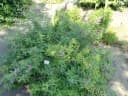
Indigofera tinctoria
Indigofera tinctoria
Safety & Hazards
None known
Cultivation Details
Indigofera tinctoria is a plant of the tropics and subtropics, where it is found at elevations up to 1,600 metres. It grows best in areas where annual daytime temperatures are within the range 22 - 28°c, but can tolerate 7 - 32°c[1]. It prefers a mean annual rainfall in the range 1,300 - 1,700mm, but tolerates 640 - 3,000mm[1]. Requires a position in full sun, succeeding in any deep, well-drained and moderately retentive and fertile soil[2]. Prefers a pH in the range 6 - 7, tolerating 4.3 - 8.7[1]. Requires a position sheltered from hot winds[1]. Indigofera tinctoria has been widely spread through the tropics and subtropics as a result of cultivation as a dye plant. It has the potential to invade native ecosystems and poses both a present and a future threat. The species was included in Kaufman's 2013 'Invasive Plants of North America'[3]. Branches are harvested by cutting 10 - 20cm above ground level when the plants are 4 - 5 months old and have formed a closed stand, usually at the flowering stage[4]. The crop should be harvested promptly because heavy rains or flooding can destroy it in a few hours. In India harvested branches are tied into bundles of about 130 kg and transported to the dye factory. Up to 3 harvests are possible per year[4]. Dye yields can be 1.6 - 5.4 tonnes per hectare[1]. This species has a symbiotic relationship with certain soil bacteria, these bacteria form nodules on the roots and fix atmospheric nitrogen. Some of this nitrogen is utilized by the growing plant but some can also be used by other plants growing nearby[5].
Propagation
Seed - pre-soak overnight in warm water and sow in a seedbed with partial shade. Germination takes about 4 days[4]. Like many species within the family Fabaceae, once they have been dried for storage the seeds of this species may benefit from scarification before sowing in order to speed up and improve germination. This can usually be done by pouring a small amount of nearly boiling water on the seeds (being careful not to cook them!) and then soaking them for 12 - 24 hours in warm water. By this time they should have imbibed moisture and swollen - if they have not, then carefully make a nick in the seedcoat (being careful not to damage the embryo) and soak for a further 12 hours before sowing[PFAF]. Semi-ripe cuttings of lateral shoots with a heel[2]. Root cuttings. Cite as: Tropical Plants Database, Ken Fern. tropical.theferns.info. 2026-02-20. <tropical.theferns.info/viewtropical.php?id=Indigofera+tinctoria>
Pollinators
Data unavailable
References
- [1]Ecocrop — http://ecocrop.fao.org/ecocrop/srv/en/home ↩︎Basic information on a wide range of useful plants, plus details of environmental needs where available.
- [2]The New RHS Dictionary of Gardening. 1992. — Huxley. A. · MacMillan Press · 1992 · ISBN 0-333-47494-5 ↩︎Excellent and very comprehensive, though it contains a number of silly mistakes. Readable yet also very detailed.
- [3]Invasive Species Compendium — http://www.cabi.org ↩︎An immense resource - in depth information on over 900 species of invasive plants (it also has information on animals, fungi etc).
- [4]Protabase - Plant Resources of Tropical Africa. — http://www.prota.org ↩︎An excellent on-line database with detailed information on over 3,200 species of useful plants of Africa.
- [5]Nodulation Plants in GRIN Taxonomy — United States Department of Agriculture · http://www.ars-grin.gov/~sbmljw/cgi-bin/taxnodul.pl?language=en ↩︎An online database listing plants that have either positive or negative reports on root and stem nodulation with nitrogen-fixing bacteria.
- [6]Mansfeld's Database of Agricultural and Horticultural Plants — http://mansfeld.ipk-gatersleben.de/pls/htmldb_pgrc/f?p=185:3:4292127278597336 ↩︎Terse details of a huge range of useful plants.
- [7]Cornucopia II — Facciola. S. · Kampong Publications, California. · 1998 · ISBN 0-9628087-2-5 ↩︎The second edition of an excellent guide to the edible uses of plants, though it does not give any details of cultivation etc.
- [8]Polyphenol Contents and Antioxidant Activities of Five Indigofera Species (Fabaceae) from Burkina Faso — Bakasso S.; Lamien-Meda A.; Lamien C.E.; Kiendrebeogo M.; Mi · 2008 · ISBN 1028-8880 ↩︎
- [9]Dictionary of Economic Plants. — Uphof. J. C. Th. · Weinheim · 1959 · ISBN - ↩︎An excellent and very comprehensive guide but it only gives very short descriptions of the uses without any details of how to utilize the plants. Not for the casual reader.
- [10]World Agroforesty Centre — http://www.worldagroforestry.org/ ↩︎An excellent online database of a huge range of trees giving very good information on each plant - its uses, ecology, identity, propagation, pests etc.
- [11]CosIng — http://ec.europa.eu/growth/tools-databases/cosing/ ↩︎CosIng is the European Commission database for information on cosmetic substances and ingredients.
- [PFAF]Plants for a Future — pfaf.org ↩︎