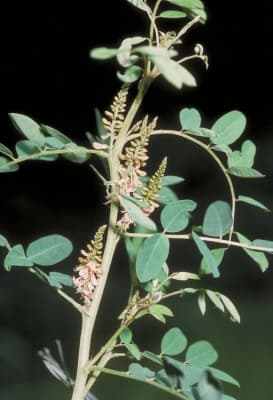
Indigofera suffruticosa
Indigofera suffruticosa
Safety & Hazards
An aqueous extract of the fruit has an hepatotoxic effect and causes chromosome aberrations[1].
Cultivation Details
Indigofera suffruticosa succeeds in tropical and subtropical climates, growing best where the mean annual temperature is wirthin the range 15 - 27°c. Plants are not frost resistant according to one report[2], whilst another says that occasional light frosts are tolerated[3]. Prefers a mean annual rainfall in the range 700 - 4,000mm[3].. Grows best in a sunny position, succeeding in a range of soil conditions so long as they are well-drained[3]. Well adapted to fertile silty-sandy soils[2]. Succeeds in soils with low fertility[2]. Grows well in soils with a low pH[2]. Established plants are drought resistant[2]. Indigofera suffruticosa is native to the Americas but has been widely introduced elsewhere as a source of dye and for medicinal purposes and has commonly become naturalized. It tolerates a range of soil types and may become dominant in disturbed habitats. It is now classed as invasive on many Pacific Islands including Hawaii, Samoa, Tonga, the Cook Islands and Fiji. It is not often a weed of crops but tends to replace native vegetation. In Hawaii it threatens the endangered species Panicum fauriei var. carteri, Spermolepis hawaiiensis and Wilkesia hobdyi[3]. This species has a symbiotic relationship with certain soil bacteria, these bacteria form nodules on the roots and fix atmospheric nitrogen. Some of this nitrogen is utilized by the growing plant but some can also be used by other plants growing nearby[4].
Propagation
Seed - sowing is done either in seed-beds or directly into the field[1]. Pre-soak the seed in warm water overnight for optimal germination[1]. Germination takes 4 - 6 days[1]. Seedlings quickly develop a deep root system and so, when a seed-bed is used the seedlings should be transplanted into their permanent positions within 4 - 6 weeks after sowing[1]. Stem cuttings are taken from well developed branches divided into 30 cm long pieces[1]. They are kept for 2 - 3 days in a cool place before planting out, 2 - 3 per hole. Rooting starts in the second week[1]. Cite as: Tropical Plants Database, Ken Fern. tropical.theferns.info. 2026-02-20. <tropical.theferns.info/viewtropical.php?id=Indigofera+suffruticosa>
Pollinators
Data unavailable
References
- [1]Plant Resources of Southeast Asia — http://proseanet.org/ ↩︎Lots of information on the uses of the plants of SE Asia.
- [2]Grassland Species - Profiles — http://www.fao.org/ag/AGP/AGPC/doc/Gbase/Default.htm ↩︎Terse information on over 650 species of plants that grow in grassland, including trees, shrubs and perennial plants as well as grasses. Gives a brief description of the plant, its range and habitat and some of its uses.
- [3]Invasive Species Compendium — http://www.cabi.org ↩︎An immense resource - in depth information on over 900 species of invasive plants (it also has information on animals, fungi etc).
- [4]Nodulation Plants in GRIN Taxonomy — United States Department of Agriculture · http://www.ars-grin.gov/~sbmljw/cgi-bin/taxnodul.pl?language=en ↩︎An online database listing plants that have either positive or negative reports on root and stem nodulation with nitrogen-fixing bacteria.
- [5]Flora of Guatemala — Standley P.C. & J. A. Steyermark · 1946 - 1976 · http://www.archive.org/ ↩︎A superb reference, though somewhat dated. Gives lots of plant uses as well as information on plant habit and habitat. The entire flora (13 volumes) can now be downloaded from http://www.archive.org/
- [6]Flowers of India — http://www.flowersofindia.net/ ↩︎A wed site of native Indian plants, plus cultivated and naturalized species. It has good quality photos and terse details on more than 3,000 species and cultivars.
- [7]Medicinal Plants of the Guianas — DeFilipps, R. A.; Maina, S. L.; & Crepin, J. · Smithsonian Museum · http://botany.si.edu/bdg/medicinal/index.html ↩︎A down-loadable PDF document of a book in pre-publication awaiting illustration. An excellent, if rather terse, guide to the traditional medicinal uses of the plants of the region
- [8]CosIng — http://ec.europa.eu/growth/tools-databases/cosing/ ↩︎CosIng is the European Commission database for information on cosmetic substances and ingredients.
- [9]Green Manures and Manuring in the Tropics — Sornay P. De. Translated by Flattely F.W. · John Bale, Sons and Danielsson Ltd.: London · 1916 · http://www.biodiversitylibrary.org ↩︎An excellent work on the subject, even if it was written almost 100 years ago. It also includes a section of useful Legumes. Can be downloaded from the Internet.