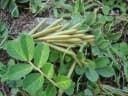
Indigofera hendecaphylla
Indigofera hendecaphylla
Safety & Hazards
Some strains of this species have leaves and seeds that are highly hepatotoxic[1]. The leaves of Indigofera hendecaphylla, possibly only of tetraploid forms originally from Sri Lanka, contain per 100 g dry matter 0.1 - 0.5 g indospicine (2,7-diamino-7-amino-heptanoic acid) while the seeds contain 0.1 - 2 g. Indospicine is a specific antagonist of arginine, interfering with its synthesis and incorporation into proteins and with the synthesis of DNA. Indospicine is highly toxic to chicken, rabbits, pigs, goats, sheep, cattle and horses. In small doses it causes loss of vitality and abortion in cattle and goats. Indospicine is especially dangerous to horses, which relish plants containing it and eat them preferentially[1]..
Cultivation Details
Indigofera hendecaphylla is a plant mainly of the tropical lowlands, where it thrives at elevations below 700 metres, though can also be found ascending to about 2,500 metres. It grows best in areas with a mean annual temperature of 16 - 27°c and a mean annual rainfall in the range 600 - 1,500mm, but may also be found in wetter locations receiving up to 4,000mm[1]. In cultivation, the plant is fairly resistant to drought and shade[1]. Under heavy shade however, such as in old rubber plantations, growth is poor[1]. It performs best on clay soils, but grows on various soil types, including sandy soils, with a pH of 5.0 - 7.7. It is tolerant of poor, moderately acid, phosphorus-deficient soils[1]. Soil covers of Indigofera hendecaphylla are notorious for harbouring snakes and leeches[1]. Seedlings develop a strong taproot which assists in loosening the soil[1]. When cuttings are used plant growth remains very low, the cover rarely exceeding 12 cm in height. A fair cover can be formed in 6 months and a continuous even cover in a year from planting[1]. The plants send out trailing stems which, under favourable conditions, may attain a length of 2 metres, producing numerous adventitious roots at the nodes. As the plants mature they become taller and at 2 years of age they are usually about 30 - 40cm tall. Vigorous regrowth occurs at the start of the rainy season[1]. Once established, Indigofera hendecaphylla is self-sowing[1]. This species has a symbiotic relationship with certain soil bacteria; these bacteria form nodules on the roots and fix atmospheric nitrogen. Some of this nitrogen is utilized by the growing plant but some can also be used by other plants growing nearby[2].
Propagation
Seed - it has a hard seedcoat and may benefit from scarification before sowing in order to speed up and improve germination. This can usually be done by pouring a small amount of nearly boiling water on the seeds (being careful not to cook them!) and then soaking them for 12 - 24 hours in warm water. By this time they should have imbibed moisture and swollen - if they have not, then carefully make a nick in the seedcoat (being careful not to damage the embryo) and soak for a further 12 hours before sowing. To obtain a good distribution of the seed it is mixed with sand or filtered dry soil at a ratio of seed to sand of 1 : 4 before sowing. If planted in rows 60cm apart the seed rate is about 3.3 kg/ha[1]. Stem cuttings[1]. Cuttings of about 20cm long are planted at a spacing of 60cm x 60cm with 5 cuttings per hole[1]. Cite as: Tropical Plants Database, Ken Fern. tropical.theferns.info. 2026-02-20. <tropical.theferns.info/viewtropical.php?id=Indigofera+hendecaphylla>
Pollinators
Data unavailable
References
- [1]Plant Resources of Southeast Asia — http://proseanet.org/ ↩︎Lots of information on the uses of the plants of SE Asia.
- [2]Nodulation Plants in GRIN Taxonomy — United States Department of Agriculture · http://www.ars-grin.gov/~sbmljw/cgi-bin/taxnodul.pl?language=en ↩︎An online database listing plants that have either positive or negative reports on root and stem nodulation with nitrogen-fixing bacteria.
- [3]Flora of China — Missouri Botanical Garden Press; St. Louis. · 1994 · http://flora.huh.harvard.edu/china/ ↩︎An excellent, comprehensive resource in 25 volumes. In addition to the botanical information the flora also gives basic information on habitat and some uses. An on-line version is also available.
- [4]African Flowering Plants Database — Conservatoire et Jardin Botaniques. · http://www.ville-ge.ch/musinfo/bd/cjb/africa/recherche.php ↩︎Contains information on over 150,000 plant names (including synonyms) giving a description and habitat, plus a distribution map.
- [5]Mansfeld's Database of Agricultural and Horticultural Plants — http://mansfeld.ipk-gatersleben.de/pls/htmldb_pgrc/f?p=185:3:4292127278597336 ↩︎Terse details of a huge range of useful plants.
- [6]Protabase - Plant Resources of Tropical Africa. — http://www.prota.org ↩︎An excellent on-line database with detailed information on over 3,200 species of useful plants of Africa.
- [7]World Agroforesty Centre — http://www.worldagroforestry.org/ ↩︎An excellent online database of a huge range of trees giving very good information on each plant - its uses, ecology, identity, propagation, pests etc.