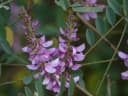
Indigofera cassioides
Indigofera cassioides
Safety & Hazards
None known
Cultivation Details
Indigofera cassioides is native to subtropical and tropical climates in southern Asia. It is not very cold-hardy, the stems tolerating occasional short-lived drops down to around -5°c when dormant[1]. The rootstock is somewhat hardier, and plants are capable of regrowing from the base if they are cut back by winter cold - though we do not know at what temperature the roots of this plant are killed[PFAF]. Requires a light or medium well-drained soil and a sunny position[2, 1]. Succeeds on chalk[2]. Plants in this genus are notably resistant to honey fungus[1]. This species has a symbiotic relationship with certain soil bacteria, these bacteria form nodules on the roots and fix atmospheric nitrogen. Some of this nitrogen is utilized by the growing plant but some can also be used by other plants growing nearby[3].
Propagation
Seed - it has a hard seedcoat and may benefit from scarification before sowing in order to speed up and improve germination. This can usually be done by pouring a small amount of nearly boiling water on the seeds (being careful not to cook them!) and then soaking them for 12 - 24 hours in warm water. By this time they should have imbibed moisture and swollen - if they have not, then carefully make a nick in the seedcoat (being careful not to damage the embryo) and soak for a further 12 hours before sowing.. Sow late winter in a warm greenhouse. The germination can be variable. Prick out the seedlings when large enough to handle and overwinter the young plants in a greenhouse for the first winter, planting out in late spring or early summer after the last expected frosts[4]. Cuttings of half-ripe wood, 5 - 8cm with a heel if possible, mid summer in individual pots in a frame. Good percentage[4]. Overwinter the young plants in a greenhouse for the first winter and plant out in late spring or early summer[2]. Root cuttings 3cm long in December. Good percentage[4]. Suckers. Remove them in the dormant season, preferably towards the end of winter, and plant out into their permanent positions. Cite as: Temperate Plants Database, Ken Fern. temperate.theferns.info. 2026-02-21. <temperate.theferns.info/plant/Indigofera+cassioides>
Pollinators
Insects
References
- [1]The New RHS Dictionary of Gardening. 1992. — Huxley. A. · MacMillan Press · 1992 · ISBN 0-333-47494-5 ↩︎Excellent and very comprehensive, though it contains a number of silly mistakes. Readable yet also very detailed.
- [2]Trees and Shrubs Hardy in Great Britain. Vol 1 - 4 and Supplement. — Bean. W. · Murray · 1981 · ISBN - ↩︎A classic with a wealth of information on the plants, but poor on pictures.
- [3]Nodulation Plants in GRIN Taxonomy — United States Department of Agriculture · http://www.ars-grin.gov/~sbmljw/cgi-bin/taxnodul.pl?language=en ↩︎An online database listing plants that have either positive or negative reports on root and stem nodulation with nitrogen-fixing bacteria.
- [4]Propagation of Trees, Shrubs and Conifers. — Sheat. W. G. · MacMillan and Co · 1948 · ISBN - ↩︎A bit dated but a good book on propagation techniques with specific details for a wide range of plants.
- [5]Flora of China — Missouri Botanical Garden Press; St. Louis. · 1994 · http://flora.huh.harvard.edu/china/ ↩︎An excellent, comprehensive resource in 25 volumes. In addition to the botanical information the flora also gives basic information on habitat and some uses. An on-line version is also available.
- [6]Forest Flora of Chakrata, Dehra Dun and Saharanpur. — Gupta. B. L. · Forest Research Institute Press · 1945 · ISBN - ↩︎A good flora for the middle Himalayan forests, sparsly illustrated. Not really for the casual reader.
- [7]Plants for Human Consumption. — Kunkel. G. · Koeltz Scientific Books · 1984 · ISBN 3874292169 ↩︎An excellent book for the dedicated. A comprehensive listing of Latin names with a brief list of edible parts.
- [8]Cornucopia - A Source Book of Edible Plants. — Facciola. S. · Kampong Publications · 1990 · ISBN 0-9628087-0-9 ↩︎Excellent. Contains a very wide range of conventional and unconventional food plants (including tropical) and where they can be obtained (mainly N. American nurseries but also research institutes and a lot of other nurseries from around the world.
- [9]Glossary of Indian Medicinal Plants (Including the Supplement). — Chopra. R. N., Nayar. S. L. and Chopra. I. C. · Council of Scientific and Industrial Research, New Delhi. · 1986 · ISBN - ↩︎Very terse details of medicinal uses of plants with a wide range of references and details of research into the plants chemistry. Not for the casual reader.
- [10]Green Manures and Manuring in the Tropics — Sornay P. De. Translated by Flattely F.W. · John Bale, Sons and Danielsson Ltd.: London · 1916 · http://www.biodiversitylibrary.org ↩︎An excellent work on the subject, even if it was written almost 100 years ago. It also includes a section of useful Legumes. Can be downloaded from the Internet.
- [PFAF]Plants for a Future — pfaf.org ↩︎