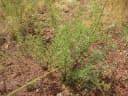
Indigofera arrecta
Indigofera arrecta
Safety & Hazards
None known
Cultivation Details
A plant of the moist tropics, where it is found at elevations from 300 - 2,700 metres. It grows best in areas where annual daytime temperatures are within the range 22 - 30°c, but can tolerate 16 - 36°c[1]. It can be killed by temperatures of °c or lower[1]. It prefers a mean annual rainfall in the range 1,700 - 2,200mm, but tolerates 400 - 4,300mm[1]. Prefers a hot, moist climate and a position in full sun[2]. Succeeds in a range of soils[1]. Prefers a pH in the range 5 - 6, tolerating 4.5 - 6.5[1]. Plants can tolerate up to two months of waterlogging[2]. Plants can commence flowering 3 months after sowing the seed[3]. Branches are harvested, usually early in the morning, when the plants are 4 - 5 months old and the crop has made a closed stand. This is usually also the flowering stage. About 3 - 4 months later the plants can be cut again; a crop can be harvested three times a year[2]. The total life span for dye crops is 2 - 3 years, whilst for cover crops it is 1.5 - 2 years[2, 1]. Indigo is harvested only once when grown on paddy soils because the plants must give way for the next rice crop[2]. The yield of this species is higher than from any other species of Indigofera. Annuals yields of 22 - 100 tonnes green matter per ha have been reported in India; the recorded output of indigo cake is 137 - 325 kg/ha per year[2]. Natural hybridizations between Indigofera arrecta and Indigofera tinctoria do occur and especially in W Africa plants are often difficult to be assigned to one of the two taxa[4]. This species has a symbiotic relationship with certain soil bacteria, these bacteria form nodules on the roots and fix atmospheric nitrogen. Some of this nitrogen is utilized by the growing plant but some can also be used by other plants growing nearby[5].
Propagation
Seed - it possess a hard seed-coat and must be scarified[2]. This can usually be done by pouring a small amount of nearly boiling water on the seeds (being careful not to cook them!) and then soaking them for 12 - 24 hours in warm water. By this time they should have imbibed moisture and swollen - if they have not, then carefully make a nick in the seedcoat (being careful not to damage the embryo) and soak for a further 12 hours before sowing. Sowing is done either on seed-beds or directly into the field, 3 - 4 seeds per hole, 60 cm apart within rows and 45 - 60 cm between rows[2]. Germination takes about 4 days[2]. When seed-beds are used, seedlings are transplanted at 4 - 6 weeks[2]. Cuttings are made by dividing well-developed branches into pieces 30 cm long, which are kept for 2 - 3 days in a cool place before planting[2]. Cuttings, 2-3 per hole, start rooting by the second week[2]. Cite as: Tropical Plants Database, Ken Fern. tropical.theferns.info. 2026-02-20. <tropical.theferns.info/viewtropical.php?id=Indigofera+arrecta>
Pollinators
Data unavailable
References
- [1]Ecocrop — http://ecocrop.fao.org/ecocrop/srv/en/home ↩︎Basic information on a wide range of useful plants, plus details of environmental needs where available.
- [2]World Agroforesty Centre — http://www.worldagroforestry.org/ ↩︎An excellent online database of a huge range of trees giving very good information on each plant - its uses, ecology, identity, propagation, pests etc.
- [3]Protabase - Plant Resources of Tropical Africa. — http://www.prota.org ↩︎An excellent on-line database with detailed information on over 3,200 species of useful plants of Africa.
- [4]Mansfeld's Database of Agricultural and Horticultural Plants — http://mansfeld.ipk-gatersleben.de/pls/htmldb_pgrc/f?p=185:3:4292127278597336 ↩︎Terse details of a huge range of useful plants.
- [5]Nodulation Plants in GRIN Taxonomy — United States Department of Agriculture · http://www.ars-grin.gov/~sbmljw/cgi-bin/taxnodul.pl?language=en ↩︎An online database listing plants that have either positive or negative reports on root and stem nodulation with nitrogen-fixing bacteria.
- [6]African Flowering Plants Database — Conservatoire et Jardin Botaniques. · http://www.ville-ge.ch/musinfo/bd/cjb/africa/recherche.php ↩︎Contains information on over 150,000 plant names (including synonyms) giving a description and habitat, plus a distribution map.
- [7]Medicinal Plants in Nigeria (website) — Professor Tolu Odugbemi · http://www.medicinalplantsinnigeria.com/uploads/1/7/4/8/17482593/plantsdatabase.xls ↩︎An on-line database, downloadable in .xls format, it has basic information on 628 species of plants