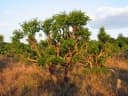
Ilex paraguariensis
Ilex paraguariensis
Safety & Hazards
Although no specific reports of toxicity have been seen for this species, Ilex species in general contain several potentially toxic compounds, particularly saponins, glycosides and triterpenoids. These compounds also often have a range of potential health benefits[1, 2, 3]. The berries are usually the part of the plant most likely to be toxic, though the degree of toxicity is usually low. Their bitter flavour usually prevents a person eating more than one or two, but even a small handful of the fruit eaten by a healthy adult is unlikely to cause more than feelings of nausea that can lead on to vomiting and diarrhoea[2]. The compounds in the leaves are particularly interesting. The leaves of many Ilex species around the world are commonly used to make health-promoting teas that, when drunk on a regular basis, help to regulate bodily functions and can reduce the risk of heart disease, lower blood-cholesterol levels etc (See Ilex paraguariensis or Ilex kaushue for examples)[3]. Even these teas, however, if taken in very concentrated doses, can act as a laxative or cause vomiting. Indeed, several species are used by traditional peoples to induce vomiting as a means of purifying the body (see Ilex guayusa or Ilex vomitoria for examples)
Cultivation Details
Ilex paraguariensis is a plant of the subtropics and tropics, also able to be grown in the warm temperate zone. It is found at elevations up to 1,500 metres. It grows best in areas where annual daytime temperatures are within the range 17 - 26°c, but can tolerate 12 - 30°c[4]. Mature plants can be killed by temperatures of -6°c or lower, but young growth can be severely damaged at -1°c[4]. It prefers a mean annual rainfall in the range 1,200 - 2,000mm, but tolerates 700 - 2,500mm[4]. Prefers a sunny position, also succeeding in light shade[4]. Succeeds in a range of well-drained soils[4]. Prefers a rich, slightly acid soil in light shade[5]. Prefers a pH in the range 6.5 - 7, tolerating 5.8 - 8[4]. Young plants are very slow to establish when planted out[6]. Plants are dioecious. Both male and female forms need to be grown if fruit and seed are required[5].
Propagation
Seed - very slow, it can take 2 - 3 years to germinate[5]. It must be stratified or sown immediately, otherwise it quickly loses its viability[7]. It is best to stratify the seed for 4 - 7 months in warm, humid sand to allow the seed to finish ripening before sowing the seed in a shaded seedbed[6]. Germination should then occur within a few days[6]. Seedlings should be ready to plant out into their permanent positions 10 - 11 months later[6]. Cuttings. Grafting. Cite as: Tropical Plants Database, Ken Fern. tropical.theferns.info. 2026-02-20. <tropical.theferns.info/viewtropical.php?id=Ilex+paraguariensis>
Pollinators
Butterflies, Insects
References
- [1]Illustrated Flora of North Central Texas — Diggs, Jnr. G.M.; Lipscomb. B. L. & O'Kennon. R. J · Botanical Research Institute, Texas. · 1999 · http://artemis.austincollege.edu/acad/bio/gdiggs/NCTXpdf.htm · ISBN 1-889878-01-4 ↩︎An excellent flora, which is also available on-line.
- [2]Poisonous Plants of North Carolina — http://www.ces.ncsu.edu/depts/hort/consumer/poison/poison.htm ↩︎An excellent concise but comprehensive guide to toxic plants that grow in N. Carolina. It lists even those plants that are of very low toxicity, including several well-known food plants such as carrots and potatoes.
- [3]Genus Ilex L.: Phytochemistry, Ethnopharmacology, and Pharmacology — Fan Yi, Xiao-ling Zhao, Yong Peng, Pei-gen Xiao · 2016 · http://10.1016/S1674-6384(16)60044-8 ↩︎
- [4]Ecocrop — http://ecocrop.fao.org/ecocrop/srv/en/home ↩︎Basic information on a wide range of useful plants, plus details of environmental needs where available.
- [5]Tropical and Subtropical Trees - A Worldwide Encyclopaedic Guide. — Barwick. M. · Thames & Hudson, London · 2004 · ISBN 0-500-51181-0 ↩︎A superb book, very concise and well written, giving a wealth of information on 400 or more species including descriptions, habitat, cultivation details and plant uses. A wealth of colour photographs bring each plant vividly to life.
- [6]Brazilian Trees. Volume 1. 4th Edition. — Lorenzi. H. · Instituto Plantarum De Estudos Da Flora; Brazil. · 2002 · ISBN 85-86714-17-8 ↩︎Information on 350 species of Brazilian trees. Stunning photographs of each species, brief details on the plant, its uses and how to grow it from seed. A superb work, with the minor irritation that the translation from Portuguese is not of the best.
- [7]Neglected Crops: 1492 from a Different Perspective — Hernándo Bermejo J. E. & León J. (Editors) · Food and Agriculture Organization of the United Nations; Rome · 1994 · ISBN 92-5-103217-3 ↩︎Concise information on many less well known crops from S. America. It can be downloaded from the Internet.
- [8]Plant Resources of Southeast Asia — http://proseanet.org/ ↩︎Lots of information on the uses of the plants of SE Asia.
- [9]The Encyclopedia of Medicinal Plants — Chevallier. A. · Dorling Kindersley. London · 1996 · ISBN 9-780751-303148 ↩︎An excellent guide to over 500 of the more well known medicinal herbs from around the world.
- [10]CosIng — http://ec.europa.eu/growth/tools-databases/cosing/ ↩︎CosIng is the European Commission database for information on cosmetic substances and ingredients.