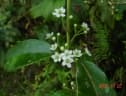
Ilex mitis
Ilex mitis
Safety & Hazards
Although no specific reports of toxicity have been seen for this species, Ilex species in general contain several potentially toxic compounds, particularly saponins, glycosides and triterpenoids. These compounds also often have a range of potential health benefits[1, 2, 3]. The berries are usually the part of the plant most likely to be toxic, though the degree of toxicity is usually low. Their bitter flavour usually prevents a person eating more than one or two, but even a small handful of the fruit eaten by a healthy adult is unlikely to cause more than feelings of nausea that can lead on to vomiting and diarrhoea[2]. The compounds in the leaves are particularly interesting. The leaves of many Ilex species around the world are commonly used to make health-promoting teas that, when drunk on a regular basis, help to regulate bodily functions and can reduce the risk of heart disease, lower blood-cholesterol levels etc (See Ilex paraguariensis or Ilex kaushue for examples)[3]. Even these teas, however, if taken in very concentrated doses, can act as a laxative or cause vomiting. Indeed, several species are used by traditional peoples to induce vomiting as a means of purifying the body (see Ilex guayusa or Ilex vomitoria for examples)
Cultivation Details
Succeeds in tropical and subtropical climates at elevations from sea level to 3,500 metres. It grows in areas where temperatures can range from -3°c up to a maximum of 34°c, and the mean annual rainfall is within the range 740 - 1,500mm[4]. Grows best in a fertile, moist, well-drained soil that is slightly acidic[4]. Ilex species generally tolerate most soils that are not water-logged[5]. A fairly fast-growing tree, 80cm a year height increase being possible[6]. The tree responds well to pruning, lopping and pollarding[4]. The white flowers are sweet-scented[7]. Honey from the tree is white and is very highly-rated in Kenya[4, 7]. A dioecious species, both male and female forms need to be grown if fruit and seed are required[4].
Propagation
Seed - fresh seed grows easily. Seed collected from the tree, or those fallen below the tree should be allowed to dry. They should then be sown into a tray. Seed should be covered lightly with the soil mix and then kept damp. Although germination can be erratic, seeds usually begin to germinate 8 - 20 days after sowing[4]. Cite as: Tropical Plants Database, Ken Fern. tropical.theferns.info. 2026-02-20. <tropical.theferns.info/viewtropical.php?id=Ilex+mitis>
Pollinators
Bees
References
- [1]Illustrated Flora of North Central Texas — Diggs, Jnr. G.M.; Lipscomb. B. L. & O'Kennon. R. J · Botanical Research Institute, Texas. · 1999 · http://artemis.austincollege.edu/acad/bio/gdiggs/NCTXpdf.htm · ISBN 1-889878-01-4 ↩︎An excellent flora, which is also available on-line.
- [2]Poisonous Plants of North Carolina — http://www.ces.ncsu.edu/depts/hort/consumer/poison/poison.htm ↩︎An excellent concise but comprehensive guide to toxic plants that grow in N. Carolina. It lists even those plants that are of very low toxicity, including several well-known food plants such as carrots and potatoes.
- [3]Genus Ilex L.: Phytochemistry, Ethnopharmacology, and Pharmacology — Fan Yi, Xiao-ling Zhao, Yong Peng, Pei-gen Xiao · 2016 · http://10.1016/S1674-6384(16)60044-8 ↩︎
- [4]World Agroforesty Centre — http://www.worldagroforestry.org/ ↩︎An excellent online database of a huge range of trees giving very good information on each plant - its uses, ecology, identity, propagation, pests etc.
- [5]The New RHS Dictionary of Gardening. 1992. — Huxley. A. · MacMillan Press · 1992 · ISBN 0-333-47494-5 ↩︎Excellent and very comprehensive, though it contains a number of silly mistakes. Readable yet also very detailed.
- [6]PlantZAfrica.com — http://www.plantzafrica.com ↩︎An excellent site giving detailed descriptions and uses of many S. African plants.
- [7]The Useful Plants of West Tropical Africa. — Burkil. H. M. · Royal Botanic Gardens; Kew. · 1985 - 2004 ↩︎Brief descriptions and details of the uses of over 4,000 plants. A superb, if terse, resource, it is also available electronically on the Web - see http://www.aluka.org/
- [8]Field Guide to the Moist Forest Trees of Tanzania. — Lovett J.C.; Ruffo C.K.; Gereau R.E.; Taplin J.R.D · Frontier · http://www.york.ac.uk/res/celp/webpages/projects/ecology/tree%20guide/introduction.htm · ISBN 1-873070-33-0 ↩︎A lovely little book giving a basic identification guide to more than 650 species of trees growing in Tanzania. It is also available to view on the internet.
- [9]IUCN Red List of Threatened Species — http://www.iucnredlist.org/ ↩︎A list of plants under threat and facing possible extinction, usually with brief details of the threats and information on habitat.
- [10]Dictionary of Economic Plants. — Uphof. J. C. Th. · Weinheim · 1959 · ISBN - ↩︎An excellent and very comprehensive guide but it only gives very short descriptions of the uses without any details of how to utilize the plants. Not for the casual reader.
- [PFAF]Plants for a Future — pfaf.org ↩︎