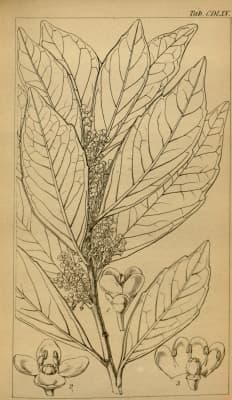
Ilex affinis
Ilex affinis
Safety & Hazards
Although no specific reports of toxicity have been seen for this species, Ilex species in general contain several potentially toxic compounds, particularly saponins, glycosides and triterpenoids. These compounds also often have a range of potential health benefits[1, 2, 3]. The berries are usually the part of the plant most likely to be toxic, though the degree of toxicity is usually low. Their bitter flavour usually prevents a person eating more than one or two, but even a small handful of the fruit eaten by a healthy adult is unlikely to cause more than feelings of nausea that can lead on to vomiting and diarrhoea[2]. The compounds in the leaves are particularly interesting. The leaves of many Ilex species around the world are commonly used to make health-promoting teas that, when drunk on a regular basis, help to regulate bodily functions and can reduce the risk of heart disease, lower blood-cholesterol levels etc (See Ilex paraguariensis or Ilex kaushue for examples)[3]. Even these teas, however, if taken in very concentrated doses, can act as a laxative or cause vomiting. Indeed, several species are used by traditional peoples to induce vomiting as a means of purifying the body (see Ilex guayusa or Ilex vomitoria for examples)
Cultivation Details
Grows best in a position with moderate shade[4]. Requires a well-drained soil, succeeding in sandy to clayey soils of medium fertility[4]. Established plants are drought tolerant[4]. A dioecious species, both male and female forms need to be grown if fruit and seed are required.
Propagation
Seed - it has a hard seedcoat and may benefit from scarification before sowing to speed up germination. This can usually be done by pouring a small amount of nearly boiling water on the seeds (being careful not to cook them!) and then soaking them for 12 - 24 hours in warm water. By this time they should have imbibed moisture and swollen - if they have not, then carefully make a nick in the seedcoat (being careful not to damage the embryo) and soak for a further 12 hours before sowing. Sow the seed in a partially shaded position in a nursery seedbed. A low germination rate can usually be expected, with the seed sprouting within 90 - 150 days[4]. When the seedlings are 5 - 6cm tall, pot them up into individual containers[4]. Cite as: Tropical Plants Database, Ken Fern. tropical.theferns.info. 2026-02-20. <tropical.theferns.info/viewtropical.php?id=Ilex+affinis>
Pollinators
Data unavailable
References
- [1]Illustrated Flora of North Central Texas — Diggs, Jnr. G.M.; Lipscomb. B. L. & O'Kennon. R. J · Botanical Research Institute, Texas. · 1999 · http://artemis.austincollege.edu/acad/bio/gdiggs/NCTXpdf.htm · ISBN 1-889878-01-4 ↩︎An excellent flora, which is also available on-line.
- [2]Poisonous Plants of North Carolina — http://www.ces.ncsu.edu/depts/hort/consumer/poison/poison.htm ↩︎An excellent concise but comprehensive guide to toxic plants that grow in N. Carolina. It lists even those plants that are of very low toxicity, including several well-known food plants such as carrots and potatoes.
- [3]Genus Ilex L.: Phytochemistry, Ethnopharmacology, and Pharmacology — Fan Yi, Xiao-ling Zhao, Yong Peng, Pei-gen Xiao · 2016 · http://10.1016/S1674-6384(16)60044-8 ↩︎
- [4]Brazilian Trees. Volume 2. 4th Edition. — Lorenzi. H. · Instituto Plantarum De Estudos Da Flora; Brazil. · 2002 · ISBN 85-86714-15-1 ↩︎Information on 350 species of Brazilian trees. Stunning photographs of each species, brief details on the plant, its uses and how to grow it from seed. A superb work, with the minor irritation that the translation from Portuguese is not of the best.
- [5]IUCN Red List of Threatened Species — http://www.iucnredlist.org/ ↩︎A list of plants under threat and facing possible extinction, usually with brief details of the threats and information on habitat.
- [6]Diccionario das Plantas Uteis do Brasil — Correa M.P. · Imprensa Nacional; Rio de Janeiro · 1926 ↩︎A massive work in 6 volumes giving details of the various uses of Brazilian plants.