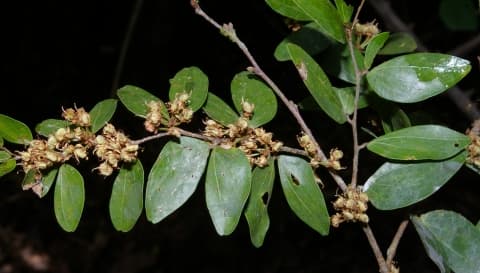
Hymenaea martiana
Hymenaea martiana
Safety & Hazards
None known
Cultivation Details
Grows best in a sunny position[1]. Grows in the wild on moist, clay soils[1]. The plant has a slow rate of growth, even when small[1]. Although many species within the family Fabaceae have a symbiotic relationship with soil bacteria, this species is said to be devoid of such a relationship and therefore does not fix atmospheric nitrogen[2].
Propagation
Seed - it has a hard seedcoat and benefits from scarification before sowing to speed up and improve germination. This can usually be done by pouring a small amount of nearly boiling water on the seeds (being careful not to cook them!) and then soaking them for 12 - 24 hours in warm water. By this time they should have imbibed moisture and swollen - if they have not, then carefully make a nick in the seedcoat (being careful not to damage the embryo) and soak for a further 12 hours before sowing. Sow the treated seed in a partially shaded position in individual containers. A germination rate in excess of 50% can be expected from treated seed, with the seed sprouting within 15 - 30 days[1]. Cite as: Tropical Plants Database, Ken Fern. tropical.theferns.info. 2026-02-20. <tropical.theferns.info/viewtropical.php?id=Hymenaea+martiana>
Pollinators
Data unavailable
References
- [1]Brazilian Trees. Volume 3. — Lorenzi. H. · Instituto Plantarum De Estudos Da Flora; Brazil. · 2009 · ISBN 85-86714-34-4 ↩︎Information on 350 species of Brazilian trees. Stunning photographs of each species, brief details on the plant, its uses and how to grow it from seed. A superb work, with the minor irritation that the translation from Portuguese is not of the best.
- [2]Nodulation Plants in GRIN Taxonomy — United States Department of Agriculture · http://www.ars-grin.gov/~sbmljw/cgi-bin/taxnodul.pl?language=en ↩︎An online database listing plants that have either positive or negative reports on root and stem nodulation with nitrogen-fixing bacteria.
- [3]Food Plants in the Americas: A Survey of the Domesticated, Cultivated, and Wild Plants Used for Human Food in North, — Kermath B.M.; Bennett B.C.' Pulsipher L.M. · 2014 ↩︎A pre-publication draft of an amazing, on-going work first started in 1985. It contains information on more than 3,900 taxa from the Americas - from Arctic regions to the Tropics
- [4]Anatomia dos órgãos vegetativos de Hymenaea martiana Hayne (CaesalpinioideaeFabaceae): espécie de uso medicinal em C — Silva M.S.; Leite K.R.B.; Saba M.D · 2012 ↩︎
- [5]Forest Stewardship Council. — http://www.fsc.dk/index.php?id=256&PHPSESSID=367043b95e93a891cf96369e9264cd03 ↩︎The site contains information on the properties of some less well-known tropical timbers. The Forest Stewardship Council works actively to protect tropical forests by encouraging sustainable harvesting of the trees.
- [6]Tropix 7 — CIRAD · http://tropix.cirad.fr/en ↩︎An on-line guide to the timbers of 245 species of trees.