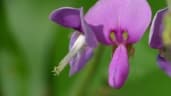
Hylodesmum podocarpum
Hylodesmum podocarpum
Safety & Hazards
None known
Cultivation Details
Hylodesmum podocarpum has a very wide range, from the cold temperate regions of northeast China to the tropical mountains of the Philippines. Requires a well-drained soil and a sunny sheltered position[1]. This species has a symbiotic relationship with certain soil bacteria, these bacteria form nodules on the roots and fix atmospheric nitrogen. Some of this nitrogen is utilized by the growing plant but some can also be used by other plants growing nearby[2].
Propagation
Seed - best sown as soon as it is ripe in a greenhouse. Scarify and pre-soak stored seed for 5 hours in warm water then sow early spring in a greenhouse. The seed usually germinates within 1 - 4 months at 25°c. Prick out the seedlings into individual pots once they are large enough to handle and grow them on in the greenhouse for their first winter. Plant them out in late spring or early summer and consider giving them some protection from frost in their first winter outdoors. Cuttings of half-ripe wood with a heel, mid summer in a frame. Division as the plant comes into growth in the spring. Larger clumps can be replanted direct into their permanent positions, though it is best to pot up smaller clumps and grow them on in a cold frame until they are rooting well. Plant them out in the spring. Root cuttings in winter. Cite as: Temperate Plants Database, Ken Fern. temperate.theferns.info. 2026-02-21. <temperate.theferns.info/plant/Hylodesmum+podocarpum>
Pollinators
Insects
References
- [1]The New RHS Dictionary of Gardening. 1992. — Huxley. A. · MacMillan Press · 1992 · ISBN 0-333-47494-5 ↩︎Excellent and very comprehensive, though it contains a number of silly mistakes. Readable yet also very detailed.
- [2]Nodulation Plants in GRIN Taxonomy — United States Department of Agriculture · http://www.ars-grin.gov/~sbmljw/cgi-bin/taxnodul.pl?language=en ↩︎An online database listing plants that have either positive or negative reports on root and stem nodulation with nitrogen-fixing bacteria.
- [3]Flora of China — Missouri Botanical Garden Press; St. Louis. · 1994 · http://flora.huh.harvard.edu/china/ ↩︎An excellent, comprehensive resource in 25 volumes. In addition to the botanical information the flora also gives basic information on habitat and some uses. An on-line version is also available.
- [4]Plants for Human Consumption. — Kunkel. G. · Koeltz Scientific Books · 1984 · ISBN 3874292169 ↩︎An excellent book for the dedicated. A comprehensive listing of Latin names with a brief list of edible parts.
- [5]Analgesic, anti-inflammatory and antipyretic activities of the petroleum ether fraction from the ethanol extract of — Zhan-Zhou Zhu et al · 2011 · http://10.1016/j.jep.2010.11.042 ↩︎
- [6]Medicinal Plants of China — Duke. J. A. and Ayensu. E. S. · Reference Publications, Inc. · 1985 · ISBN 0-917256-20-4 ↩︎Details of over 1,200 medicinal plants of China and brief details of their uses. Often includes an analysis, or at least a list of constituents. Heavy going if you are not into the subject.