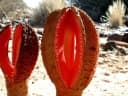
Hydnora africana
Hydnora africana
Safety & Hazards
None known
Cultivation Details
It is thought that the plant excretes powerful enzymes that dissolve away the hard tissue of the host in order to attach itself[1]. The flowers bear no real resemblance to normal flowers other than being colourful in order to advertise themselves to potential pollinators. White bait bodies are found on the inner base of the flowers. These bodies play a very important role in the life cycle of the plant. They omit a putrid odour to attract various carrion beetles and other insects which become trapped in the flowers. Numerous stiff bristles are found on the inner surface of the perianth lobes which restrain the trapped insect from escaping. After feeding on the bait bodies, the trapped insect drops down the flower tube onto the anthers collecting pollen all over its body. It then drops even further down onto the soft cushion-shaped stigma thus pollinating the flower[1].
Propagation
Seed - it is more likely to germinate when in close proximity to a host plant[1]. The germinated seed develops a primary root (primary haustorium) which establishes the first attachment point to the host. After the plant has grown and spread, it may develop several secondary haustoria, attaching itself to the same or different hosts nearby[1]. Cite as: Tropical Plants Database, Ken Fern. tropical.theferns.info. 2026-02-20. <tropical.theferns.info/viewtropical.php?id=Hydnora+africana>
Pollinators
Beetles
References
- [1]PlantZAfrica.com — http://www.plantzafrica.com ↩︎An excellent site giving detailed descriptions and uses of many S. African plants.
- [2]Edible Wild Plants of Tanzania — Ruffo, C.K.: Birnie, A. & Tengnas, B. · Regional Land Management Unit; Nairobi. · 2002 · ISBN 9966-896-60-0 ↩︎A very well presented, simple guide to growing and utilizing wild food plants in Tanzania, with line drawings of each plant, a description, habitat and range, non-food as well as food uses, plus basic information on growing the plants.
- [3]The genus Hydnora — Old Dominion University · http://www.odu.edu/~lmusselm/plant/parasitic/hydnora_intro.php ↩︎A downloaded web page giving fairly detailed information on the parasitic genus Hydnore.