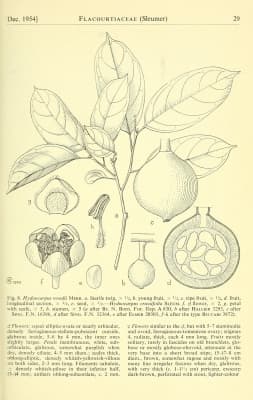
Hydnocarpus woodii
Hydnocarpus woodii
Safety & Hazards
None known
Cultivation Details
Species in this genus generally require well-drained sandy or loamy silt soils and grow best along creek beds or on the banks of streams[1]. Seeds tend to go rancid rather quickly. Therefore ripe fruits should be opened and the fruit pulp and aril removed from the seeds. Seeds are then washed and dried in the sun. Sun-dried seeds, either whole or broken, are cold-pressed or pressed under concurrent heating to extract the oil. The chemical composition of the end-product of these methods varies[2]. A dioecious species, both male and female forms need to be grown if fruit and seed are required
Propagation
Seed - best sown as soon as it is ripe, when it will usually germinate quickly. Germination of stored seed can be slow, with some species in the genus taking up to 2 years. Sow the seed in a shaded position in a nursery seedbed and keep moist. Grow on the seedlings in shade until large enough to plant out[2]. Cite as: Tropical Plants Database, Ken Fern. tropical.theferns.info. 2026-02-20. <tropical.theferns.info/viewtropical.php?id=Hydnocarpus+woodii>
Pollinators
Insects
References
- [1]The Chaulmoogra Tree and some Related Species - A survey conducted in Siam, Burma, Assam and Bengal — Rock J.F. · Government Printing Office, Washington. · 1922 ↩︎A review of various species in the genus Hydnocarpus that are the source of the medicinal oil Chaulmoogra.
- [2]Plant Resources of Southeast Asia — http://proseanet.org/ ↩︎Lots of information on the uses of the plants of SE Asia.
- [3]Flora Malesiana Series 1 — Various · Nationaal Herbarium Nederiand, Universiteit Leiden branch · http://www.archive.org ↩︎A massive treatment of the plants of the Malaysian Archipelago. Much of it has been made available to download from the Internet
- [PFAF]Plants for a Future — pfaf.org ↩︎