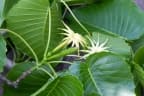
Hura polyandra
Hura polyandra
Safety & Hazards
The milk-like latex exuding copiously from the cut bark or from the broken stems or leaves is caustic upon the skin, in some persons producing blisters and intense inflammation[1]. This latex, mixed with meal or sand, is much used in Mexico as a barbasco or fish poison[1]. Although occasionally used medicinally, the seeds are known to be dangerously poisonous[1]. They are used in some areas to poison noxious animals[1]. It is claimed that a person who sleeps under one of the trees amanece muerto, or that at the least the whole body will be covered with blisters. The first portion of this statement is undoubtedly untrue, and there probably is little basis for the second part[1].
Cultivation Details
The fruit of the sandbox is curious in appearance and structure, somewhat resembling a diminutive pumpkin or cantaloupe, with the cocci arranged like the sections of an orange. When thoroughly dry, the fruit explodes elastically with great force and a loud report, scattering the seeds to some distance. The force of the explosion is great enough to burst small boxes in which the fruits may have been stored, or to cause wounds if they strike any part of the body[1].
Propagation
Seed - Cite as: Tropical Plants Database, Ken Fern. tropical.theferns.info. 2026-02-20. <tropical.theferns.info/viewtropical.php?id=Hura+polyandra>
Pollinators
Data unavailable
References
- [1]Flora of Guatemala — Standley P.C. & J. A. Steyermark · 1946 - 1976 · http://www.archive.org/ ↩︎A superb reference, though somewhat dated. Gives lots of plant uses as well as information on plant habit and habitat. The entire flora (13 volumes) can now be downloaded from http://www.archive.org/
- [2]Dictionary of Economic Plants. — Uphof. J. C. Th. · Weinheim · 1959 · ISBN - ↩︎An excellent and very comprehensive guide but it only gives very short descriptions of the uses without any details of how to utilize the plants. Not for the casual reader.