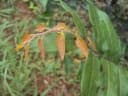
Hopea parviflora
Hopea parviflora
Safety & Hazards
None known
Cultivation Details
A plant of the moist tropics, where it is found at elevations up to 1,100 metres. It grows best in areas where annual daytime temperatures are within the range 26 - 33°c, but can tolerate 8 - 27°c[1]. It prefers a mean annual rainfall in the range 2,500 - 3,500mm, but tolerates 2,000 - 5,000mm[1]. Tolerant of shade, especially when young, though older trees require more light[2, 1]. Prefers a deep, rich, moist soil[2]. Prefers a pH in the range 5 -6, tolerating 4.5 - 6.9[1]. The species appears to be regenerating well in the wild[3]. The tree produces a long, deep taproot with only a few lateral shoots[2].
Propagation
Seed - it has a short viability and so should be sown as soon as it is ripe[2]. The seed is usually broadcast sown in the areas where it is to grow, it usually germinates quickly and well[2]. Nursery sown stock can be difficult to plant successfully as the plant cannot withstand careless handling[2]. Cite as: Tropical Plants Database, Ken Fern. tropical.theferns.info. 2026-02-20. <tropical.theferns.info/viewtropical.php?id=Hopea+parviflora>
Pollinators
Insects
References
- [1]Ecocrop — http://ecocrop.fao.org/ecocrop/srv/en/home ↩︎Basic information on a wide range of useful plants, plus details of environmental needs where available.
- [2]A Manual of Indian Timbers. — Gamble. J. S. · Bishen Singh Mahendra Pal Singh · 1972 · ISBN - ↩︎First written in the 19th century, but still a classic, giving a lot of information on the uses and habitats of Indian trees. Not for the casual reader.
- [3]The World List of Threatened Trees — Oldfield S.; Lusty C.; and MacKinven A. · World Conservation Press; Cambridge UK · 1998 · http://www.biodiversitylibrary.org · ISBN 1-899628-10 X ↩︎A list of the trees on the IUCN Red List of Threatened Plant Species in 1998, often giving some information on habitat and the reasons for being on the list. It can be downloaded from the Internet.
- [4]IUCN Red List of Threatened Species — http://www.iucnredlist.org/ ↩︎A list of plants under threat and facing possible extinction, usually with brief details of the threats and information on habitat.