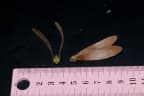
Hopea odorata
Hopea odorata
Safety & Hazards
None known
Cultivation Details
In most of the area of natural distribution it is found in lowland wet tropical forest on deep soils at elevations up to 300 metres and rarely far away from a stream[1]. It grows best in areas where annual daytime annual temperatures are within the range 26 - 36°c, but can tolerate 10 - 41°c[2]. Plants are killed by temperatures of -3°c[2]. It prefers a mean annual rainfall of 3,000 - 4,000mm, but tolerates 2,200 - 5,100mm[2]. Young plants require some shade, but become increasingly light-demanding as they grow larger[2]. Found in the wild on deep rich soil, usually along the banks of streams and in damp situations[1]. Prefers a pH in the range 4.8 - 5.2, tolerating 4.4 - 6[2]. This tree has the highest increment among the dipterocarp species, with a diameter increment of 0.97cm per year and a height increment of 51cm per year. Rotation cycles have not been calculated or developed for the species but based on growth rates of a limited number of trees, a cycle of 30 to 40 years is feasible on suitable sites[3]. The tree flowers and fruits almost regularly every two years[1].
Propagation
Seed - very light seeds should be rejected[1]. Germination takes place in 1 - 4 weeks[1]. Germination rate has been found to be 73% in unshaded beds, 83% in shaded beds and 40% in direct field sowings[1]. Bare root transplanting results in almost 100 % survival if seedlings are root pruned first[1]. Direct sowing is also usually successful[1]. Generally, a shade crop is grown to protect the young seedlings from the first hot weather and to keep weeds down. The young plants need full overhead light and the shade crop should be cut back periodically to ensure it does not overtop the tree[1]. The tree usually regenerates freely, with seedlings springing up profusely round the mother tree[1]. To encourage natural reproduction, the overhead canopy should be thinned or removed[1]. The seeds can be collected from the ground under the seed bearers and they can also be collected by lopping small branches[1]. Seeds are recalcitrant and die within five days due to dehydration[1]. If dried at 35°c to 33 % moisture content, seeds could stay viable for 1 - 2 months at 15°c, maintaining a germination rate of over 60 %[1]. If stored at 4°c, the seeds can stay viable for about three months[1]. Cite as: Tropical Plants Database, Ken Fern. tropical.theferns.info. 2026-02-20. <tropical.theferns.info/viewtropical.php?id=Hopea+odorata>
Pollinators
Thrips
References
- [1]World Agroforesty Centre — http://www.worldagroforestry.org/ ↩︎An excellent online database of a huge range of trees giving very good information on each plant - its uses, ecology, identity, propagation, pests etc.
- [2]Ecocrop — http://ecocrop.fao.org/ecocrop/srv/en/home ↩︎Basic information on a wide range of useful plants, plus details of environmental needs where available.
- [3]Digital Compendium of Forestry Species of Cambodia — www.digitalspecies.blogspot.com; Phnom Penh · 2008 · http://www.digitalspecies.blogspot.com ↩︎A very detailed booklet, produced in PDF format on the internet, giving information on around 100 species of trees.
- [4]Seed Leaflets — Various · Forest & Landscape. Denmark · http://en.sl.life.ku.dk/Publikationer/Udgivelser/PopulaerPublikationer.aspx?katid={D28373CC-6EF3-4EF8-B097-6D83FABF209E}&serieid={9F1C3DB1-6E7B-4CF1-AF53-F480B0CB40EF}&sort=title ↩︎A series of leaflets, jointly produced by the University of Copenhagen and the Royal Botanic Gardens at Kew, focussing on seed information for a number species, but also giving a lot of other information about each plant.
- [5]The World List of Threatened Trees — Oldfield S.; Lusty C.; and MacKinven A. · World Conservation Press; Cambridge UK · 1998 · http://www.biodiversitylibrary.org · ISBN 1-899628-10 X ↩︎A list of the trees on the IUCN Red List of Threatened Plant Species in 1998, often giving some information on habitat and the reasons for being on the list. It can be downloaded from the Internet.
- [6]IUCN Red List of Threatened Species — http://www.iucnredlist.org/ ↩︎A list of plants under threat and facing possible extinction, usually with brief details of the threats and information on habitat.
- [7]Trees of Laos and Vietnam - A Field Guide to 100 species. — Hoang Van Sam; Khamseng Nanthavong; Kessler P.J.A. · Blumea · 2004 ↩︎A detailed guide, with excellent line-drawings, to 100 of the more important trees of Laos and Vietnam. A very good work, giving lots of information about each plant. Originally published in the journal Blumea, it is available as a PDF on the Interne
- [8]Biotik, Laos — http://biotik.org/species_list_laos.html ↩︎Information on more than 100 species of Laotian trees.
- [9]A Manual of Indian Timbers. — Gamble. J. S. · Bishen Singh Mahendra Pal Singh · 1972 · ISBN - ↩︎First written in the 19th century, but still a classic, giving a lot of information on the uses and habitats of Indian trees. Not for the casual reader.
- [10]Gums, Resins and Latexes of Plant Origins. — Coppen J.J.W. · FAO, United Nations; Rome · 1995 · http://www.fao.org/docrep/ · ISBN 92-5-103757-4 ↩︎A handbook published by the Food and Agriculture Organisation of the United Nations, it provides good basic information on the sources and uses of the various gums, resins and latexes. It can be downloaded from the Internet.