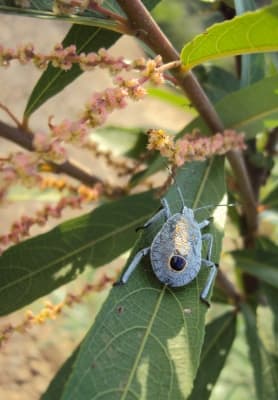
Homonoia riparia
Homonoia riparia
Safety & Hazards
The bark contains cyanogenic glycosides[1].
Cultivation Details
Found in lowland tropical areas at elevations up to 500 metres[1]. It occurs in the wild on sand, granite, shale, andesite, and other volcanic-derived material, but also on calcareous soil[1]. In its natural habitat it is regularly flooded, at least annually[1]. Its extended root system protects it against uprooting during floods; even floods that completely submerge the shrub during the rainy season for up to 9 months per year can be withstood[1]. The seeds are very hard and durable; they sink in water and may be transported by the river into even the sea, where they can still germinate in salt water along the coast[2].
Propagation
Seed - Cuttings. Cite as: Tropical Plants Database, Ken Fern. tropical.theferns.info. 2026-02-20. <tropical.theferns.info/viewtropical.php?id=Homonoia+riparia>
Pollinators
Wind
References
- [1]World Agroforesty Centre — http://www.worldagroforestry.org/ ↩︎An excellent online database of a huge range of trees giving very good information on each plant - its uses, ecology, identity, propagation, pests etc.
- [2]Euphorbiaceae of Malesia — http://www.nationaalherbarium.nl/euphorbs/ ↩︎An online resource that is still being developed, it gives detailed botanical descriptions of plants in the family Euphorbiaceae found growing in Malesia (the region from Peninsual Malaysia through Indonesia, the Philippines).
- [3]Mansfeld's Database of Agricultural and Horticultural Plants — http://mansfeld.ipk-gatersleben.de/pls/htmldb_pgrc/f?p=185:3:4292127278597336 ↩︎Terse details of a huge range of useful plants.
- [4]IUCN Red List of Threatened Species — http://www.iucnredlist.org/ ↩︎A list of plants under threat and facing possible extinction, usually with brief details of the threats and information on habitat.