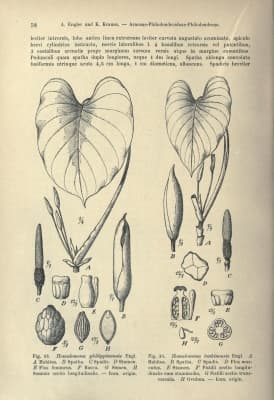
Homalomena philippinensis
Homalomena philippinensis
Safety & Hazards
Although no specific mention has been seen for this species, it belongs to a family where most of the members contain calcium oxalate crystals. This substance is toxic fresh and, if eaten, makes the mouth, tongue and throat feel as if hundreds of small needles are digging in to them. However, calcium oxalate is easily broken down either by thoroughly cooking the plant or by fully drying it and, in either of these states, it is safe to eat the plant. People with a tendency to rheumatism, arthritis, gout, kidney stones and hyperacidity should take especial caution if including this plant in their diet[1].
Cultivation Details
The base of the petioles, when pulled off, has a very sweet chewing-gum odour especially when the tissues are crushed[2].
Propagation
Seed - Cite as: Tropical Plants Database, Ken Fern. tropical.theferns.info. 2026-02-20. <tropical.theferns.info/viewtropical.php?id=Homalomena+philippinensis>
Pollinators
Insects
References
- [1]Encyclopaedia of Herbs and their Uses. — Bown. D. · Dorling Kindersley, London. · 1995 · ISBN 0-7513-020-31 ↩︎A very well presented and informative book on herbs from around the globe. Plenty in it for both the casual reader and the serious student. Just one main quibble is the silly way of having two separate entries for each plant.
- [2]Leaflets of Philippine Botany Vol. 10. — Elmer A.D.E. (Editor) · 1939 · http://www.biodiversitylibrary.org ↩︎Various plant articles. It can be downloaded from the Internet.
- [3]Minor Products of Philippine Forests — Brown. W. H. · Bureau of Forestry, Manilla. · 1920 ↩︎A useful guide to some of the plants of the area, though terse on details. The book is out of copyright and can be legally downloaded from the Internet.
- [4]An Enumeration of Philippine Flowering Plants — Merrill E.D. · Bureau of Science, Manila. · 1925 · http://www.biodiversitylibrary.org ↩︎Mainly a list of plant names, plus some synonyms, giving details of where the name was published. Also gives a note on the range of the plant, its habitat and local names. Unfortunately, it does not even give a brief description of the plant.
- [5]Dictionary of Economic Plants. — Uphof. J. C. Th. · Weinheim · 1959 · ISBN - ↩︎An excellent and very comprehensive guide but it only gives very short descriptions of the uses without any details of how to utilize the plants. Not for the casual reader.
- [6]Philippine Medicinal Plants — http://www.stuartxchange.org/CompleteList.html ↩︎A lovely site, giving brief details on the medicinal uses of several hundred (over 400 at the last count) plants in the Philippines, plus a picture of each plant.