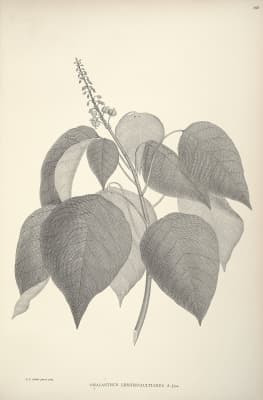
Cultivation Details
HabitEvergreen Tree
Growth—
Found in the wild on soils over granitic or sandstone rock, limestone rubble, shallow soil on rock with sulphur, ultramafic soil, silt clay, yellowish brown sandy loam, white sand, deep humus layer over clay, peaty soil, rusty red soil with concretions of iron, fertile compact soil[2]. Plants can flower and produce fruit all year round[2]. Ants' nests are commonly observed in the upper branches of the tree[2].
Propagation
Seed - Cite as: Tropical Plants Database, Ken Fern. tropical.theferns.info. 2026-02-20. <tropical.theferns.info/viewtropical.php?id=Homalanthus+populneus>
Pollinators
Data unavailable
References
- [1]Plant Resources of Southeast Asia — http://proseanet.org/ ↩︎Lots of information on the uses of the plants of SE Asia.
- [2]Euphorbiaceae of Malesia — http://www.nationaalherbarium.nl/euphorbs/ ↩︎An online resource that is still being developed, it gives detailed botanical descriptions of plants in the family Euphorbiaceae found growing in Malesia (the region from Peninsual Malaysia through Indonesia, the Philippines).
- [3]Plants of Southeast Asia — http://www.asianplant.net/ ↩︎Excellent site with brief information on the plant, its range, habitat and uses, plus phots of specimens, close-ops of flowers and leaves etc,